Solving today’s biggest atmospheric challenges with next-generation observations
STRIVE: A Leap Forward in Atmospheric Science
The Stratosphere Troposphere Response using Infrared Vertically-resolved light Explorer (STRIVE), has been selected for continued development as part of NASA’s Earth Science Explorers (ESE) program. This NASA program is designed to conduct space science missions addressing targeted observables in the 2017 Decadal Survey for Earth Science and Applications from Space.
STRIVE technology delivers an unprecedented view of the atmosphere that will enable a leap forward in our ability to predict weather, understand global pollution, monitor the ozone layer, and anticipate the climate’s future.
STRIVE Improves Extreme Weather Event Preparedness
Millions of people in the United States and billions worldwide are vulnerable to extreme weather and environmental events, including floods, droughts, heatwaves, severe storms, and wildfires. In 2024, the US experienced 27 weather disasters that caused >$1 billion in damages. These disasters resulted in hundreds of fatalities and total economic losses >$180 billion. This devastating toll on lives, infrastructure, and our economy underscores the urgent need for improved tools to better anticipate and mitigate weather impacts. This challenge requires answering questions about complex interactions within the Earth system — and solving the puzzle of troposphere-stratosphere interactions is key to unlocking new levels of predictability in weather on daily-to-monthly timescales. STRIVE pursues these answers to empower the US to be better prepared and mitigate weather losses.
STRIVE Science Serves Society and Our Country
STRIVE provides high-resolution observations essential for unraveling fine-scale processes driving the composition and dynamics of the upper troposphere and stratosphere. These insights enable transformative improvements in predictability for air quality, weather, climate, and aviation hazards.
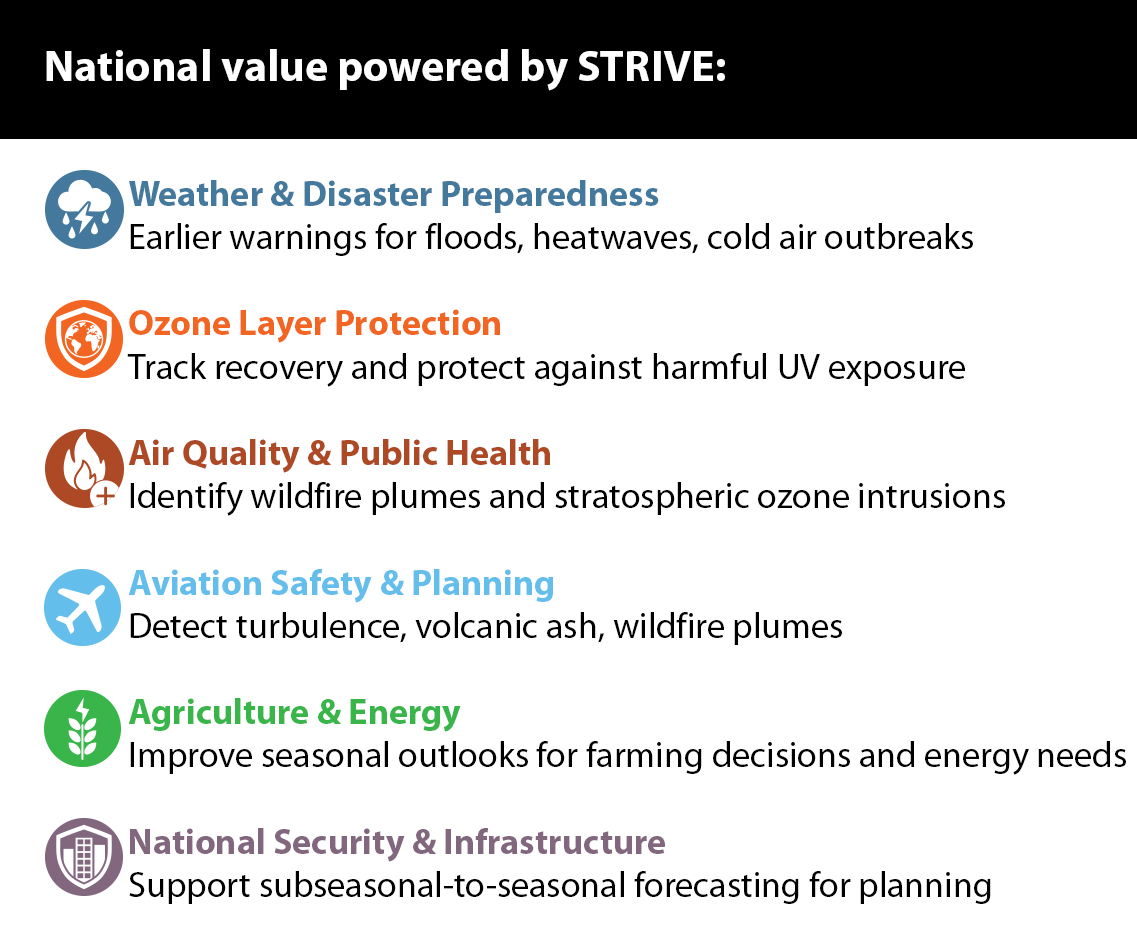
Atmospheric missions like STRIVE power the nation, with actionable insights that serve a wide variety of users — from businesses to government planners — and drive crucial decisions in sectors ranging from financial to energy to agriculture.
STRIVE rises above past capabilities, with unprecedented resolution, dense global coverage, and the ability to observe fine-scale processes in the upper atmosphere.
STRIVE observations are essential to advancing forecasts from only days into full seasons ahead.
STRIVE doesn’t merely replace existing observations—it fills a critical data gap and opens a new window on stratosphere-troposphere interactions.