| MATLAB Function Reference | |
Conjugate Gradients Squared method
Syntax
x = cgs(A,b)
cgs(A,b,tol)
cgs(A,b,tol,maxit)
cgs(A,b,tol,maxit,M)
cgs(A,b,tol,maxit,M1,M2)
cgs(A,b,tol,maxit,M1,M2,x0)
cgs(afun,b,tol,maxit,m1fun,m2fun,x0,p1,p2,...)
[x,flag] = cgs(A,b,...)
[x,flag,relres] = cgs(A,b,...)
[x,flag,relres,iter] = cgs(A,b,...)
[x,flag,relres,iter,resvec] = cgs(A,b,...)
Description
x = cgs(A,b)
attempts to solve the system of linear equations A*x = b for x. The n-by-n coefficient matrix A must be square and the column vector b must have length n. A can be a function afun such that afun(x) returns A*x.
If cgs converges, a message to that effect is displayed. If cgs fails to converge after the maximum number of iterations or halts for any reason, a warning message is printed displaying the relative residual norm(b-A*x)/norm(b) and the iteration number at which the method stopped or failed.
cgs(A,b,tol)
specifies the tolerance of the method, tol. If tol is [], then cgs uses the default, 1e-6.
cgs(A,b,tol,maxit)
specifies the maximum number of iterations, maxit. If maxit is [] then cgs uses the default, min(n,20).
cgs(A,b,tol,maxit,M) and cgs(A,b,tol,maxit,M1,M2)
use the preconditioner M or M = M1*M2 and effectively solve the system inv(M)*A*x = inv(M)*b for x. If M is [] then cgs applies no preconditioner. M can be a function that returns M\x.
cgs(A,b,tol,maxit,M1,M2,x0)
specifies the initial guess x0. If x0 is [], then cgs uses the default, an all-zero vector.
cgs(afun,b,tol,maxit,m1fun,m2fun,x0,p1,p2,...)
passes parameters p1,p2,... to functions afun(x,p1,p2,...), m1fun(x,p1,p2,...), and m2fun(x,p1,p2,...)
[x,flag] = cgs(A,b,...)
returns a solution x and a flag that describes the convergence of cgs.
Whenever flag is not 0, the solution x returned is that with minimal norm residual computed over all the iterations. No messages are displayed if the flag output is specified.
[x,flag,relres] = cgs(A,b,...)
also returns the relative residual norm(b-A*x)/norm(b). If flag is 0, then relres 
tol.
[x,flag,relres,iter] = cgs(A,b,...)
also returns the iteration number at which x was computed, where 0 iter maxit.
[x,flag,relres,iter,resvec] = cgs(A,b,...)
also returns a vector of the residual norms at each iteration, including norm(b-A*x0).
Examples
A = gallery('wilk',21);
b = sum(A,2);
tol = 1e-12;  maxit = 15;
M1 = diag([10:-1:1 1 1:10]);
x = cgs(A,b,tol,maxit,M1,[],[]);
Alternatively, use this matrix-vector product function
function y = afun(x,n)
y = [ 0;
      x(1:n-1)] + [((n-1)/2:-1:0)';
      (1:(n-1)/2)'] .*x + [x(2:n);
      0 ];
and this preconditioner backsolve function
function y = mfun(r,n)
y = r ./ [((n-1)/2:-1:1)'; 1; (1:(n-1)/2)'];
x1 = cgs(@afun,b,tol,maxit,@mfun,[],[],21);
Note that both afun and mfun must accept cgs's extra input n=21.
load west0479
A = west0479
b = sum(A,2)
[x,flag] = cgs(A,b)
flag is 1 because cgs does not converge to the default tolerance 1e-6 within the default 20 iterations.
[L1,U1] = luinc(A,1e-5)
[x1,flag1] = cgs(A,b,1e-6,20,L1,U1)
flag1 is 2 because the upper triangular U1 has a zero on its diagonal, and cgs fails in the first iteration when it tries to solve a system such as U1*y = r for y with backslash.
[L2,U2] = luinc(A,1e-6)
[x2,flag2,relres2,iter2,resvec2] = cgs(A,b,1e-15,10,L2,U2)
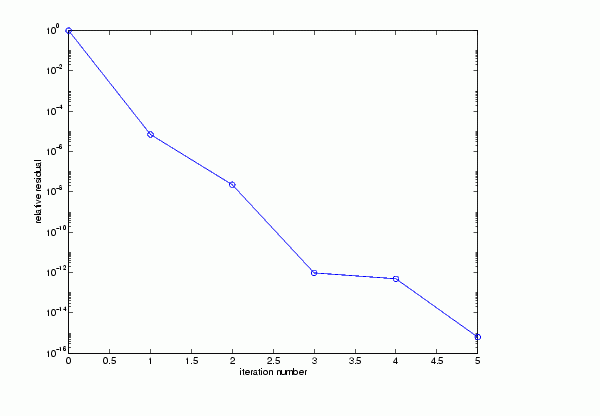
flag2 is 0 because cgs converges to the tolerance of 6.344e-16 (the value of relres2) at the fifth iteration (the value of iter2) when preconditioned by the incomplete LU factorization with a drop tolerance of 1e-6. resvec2(1) = norm(b) and resvec2(6) = norm(b-A*x2). You can follow the progress of cgs by plotting the relative residuals at each iteration starting from the initial estimate (iterate number 0) with
semilogy(0:iter2,resvec2/norm(b),'-o')
xlabel('iteration number')
ylabel('relative residual')
See Also
bicg, bicgstab, gmres, lsqr, luinc, minres, pcg, qmr, symmlq
@ (function handle), \ (backslash)
References
[1] Barrett, R., M. Berry, T. F. Chan, et al., Templates for the Solution of Linear Systems: Building Blocks for Iterative Methods, SIAM, Philadelphia, 1994.
[2] Sonneveld, Peter, "CGS: A fast Lanczos-type solver for nonsymmetric linear systems", SIAM J. Sci. Stat. Comput., January 1989, Vol. 10, No. 1, pp. 36-52.
| | cellstr | char | |