

| Design Case Studies | |
LQG Design for the y-Axis
The LQG design for the  -axis (regulation of the
  thickness) follows the exact same steps as for the
  -axis.
% Specify model components
Hy = tf(7.8e8,[1 71 88^2],'inputn','u-y')
Fiy = tf(2e4,[1 0.05],'inputn','w-iy')
Fey = tf([1e5 0],[1 0.19 9.4^2],'inputn','w-ey')
gy = 0.5e-6     % force-to-gap gain

% Build open-loop model
Py = append([ss(Hy) Fey],Fiy)
Py = [-gy gy;1 1] * Py
set(Py,'outputn',{'y-gap' 'y-force'})

% State-feedback gain design
Pydes = append(lpf,1) * Py      % Add low-freq. weigthing
set(Pydes,'outputn',{'y-gap*' 'y-force'})
ky = lqry(Pydes(1,1),1,1e-4)

% Kalman estimator design
esty = kalman(Pydes(2,:),eye(2),1e3)

% Form SISO LQG regulator for y-axis and close the loop
Regy = lqgreg(esty,ky)
cly = feedback(Py,Regy,1,2,+1)
Compare the open- and closed-loop response to the white noise input disturbances.
dt = 0.01
t = 0:dt:50
wy = sqrt(1/dt) * randn(2,length(t))

lsim(Py(1,2:3),':',cly(1,2:3),'-',wy,t)
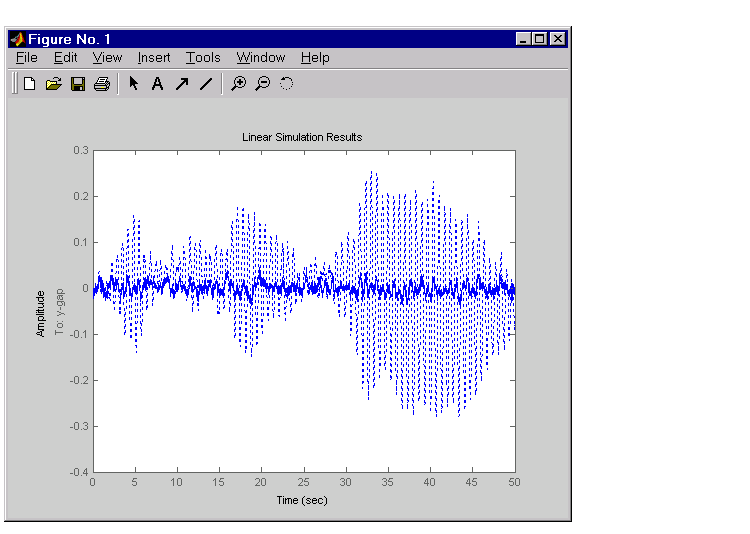
The dotted lines correspond to the open-loop response. The simulation results are comparable to those for the  -axis.
| | LQG Design for the x-Axis | Cross-Coupling Between Axes | |