

| Design Case Studies | |
Yaw Damper for a 747 Jet Transport
This case study demonstrates the tools for classical control design by stepping through the design of a yaw damper for a 747 jet transport aircraft.
The jet model during cruise flight at MACH = 0.8 and H = 40,000 ft. is
A = [-0.0558   -0.9968    0.0802    0.0415
      0.5980   -0.1150   -0.0318         0
     -3.0500    0.3880   -0.4650         0
           0    0.0805    1.0000         0];

B = [ 0.0729     0.0000
     -4.7500     0.00775
      .15300     0.1430
           0         0];

C = [0     1     0     0
     0     0     0     1];

D = [0     0
     0     0];
The following commands specify this state-space model as an LTI object and attach names to the states, inputs, and outputs.
states = {'beta' 'yaw' 'roll' 'phi'};
inputs = {'rudder' 'aileron'};
outputs = {'yaw' 'bank angle'};

sys = ss(A,B,C,D,'statename',states,...
                     'inputname',inputs,...
                     'outputname',outputs);
You can display the LTI model sys by typing sys. MATLAB responds with
a =
                      beta          yaw         roll          phi
         beta      -0.0558      -0.9968       0.0802       0.0415
          yaw        0.598       -0.115      -0.0318            0
         roll        -3.05        0.388       -0.465            0
          phi            0       0.0805            1            0


b =
                    rudder      aileron
         beta       0.0729            0
          yaw        -4.75      0.00775
         roll        0.153        0.143
          phi            0            0


c =
                      beta          yaw         roll          phi
          yaw            0            1            0            0
   bank angle            0            0            0            1


d =
                    rudder      aileron
          yaw            0            0
   bank angle            0            0

Continuous-time model.
The model has two inputs and two outputs. The units are radians for beta (sideslip angle) and phi (bank angle) and radians/sec for yaw (yaw rate) and roll (roll rate). The rudder and aileron deflections are in radians as well.
Compute the open-loop eigenvalues and plot them in the  -plane.
damp(sys)

Eigenvalue                    Damping         Freq. (rad/s)

 -7.28e-003                  1.00e+000      7.28e-003
 -5.63e-001                  1.00e+000      5.63e-001
 -3.29e-002 + 9.47e-001i     3.48e-002      9.47e-001
 -3.29e-002 - 9.47e-001i     3.48e-002      9.47e-001

pzmap(sys)
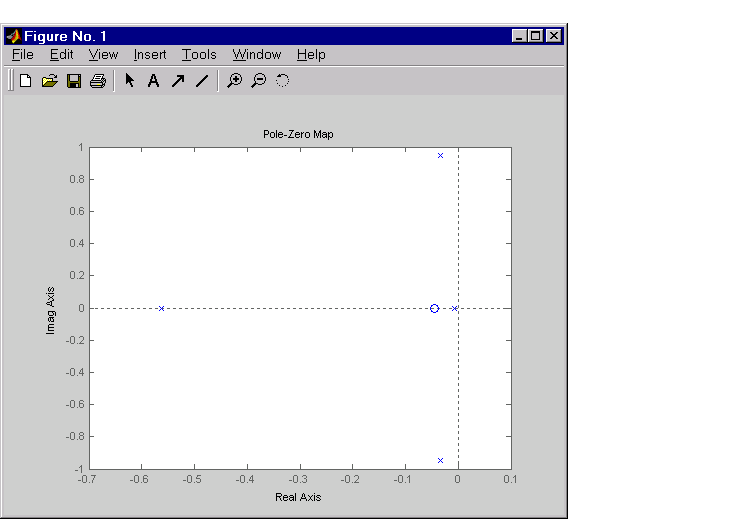
This model has one pair of lightly damped poles. They correspond to what is called the "Dutch roll mode."
Suppose you want to design a compensator that increases the damping of these poles, so that the resulting complex poles have a damping ratio  with natural frequency
  rad/sec. You can do this using the Control System toolbox analysis tools.
| | Design Case Studies | Open-Loop Analysis | |