

| Control System Toolbox Function Reference | |
Form regulator given state-feedback and estimator gains
Syntax
rsys = reg(sys,K,L)
rsys = reg(sys,K,L,sensors,known,controls)
Description
rsys = reg(sys,K,L)
forms a dynamic regulator or compensator rsys given a state-space model sys of the plant, a state-feedback gain matrix K, and an estimator gain matrix L. The gains K and L are typically designed using pole placement or LQG techniques. The function reg handles both continuous- and discrete-time cases.
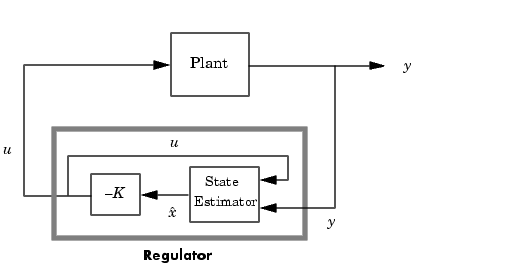
This syntax assumes that all inputs of sys are controls, and all outputs are measured. The regulator rsys is obtained by connecting the state-feedback law  and the state estimator with gain matrix
 L (see estim). For a plant with equations

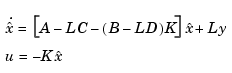
This regulator should be connected to the plant using positive feedback.
rsys = reg(sys,K,L,sensors,known,controls)
handles more general regulation problems where:
 , known inputs
  , and stochastic inputs
  .
. of the plant outputs is measured.
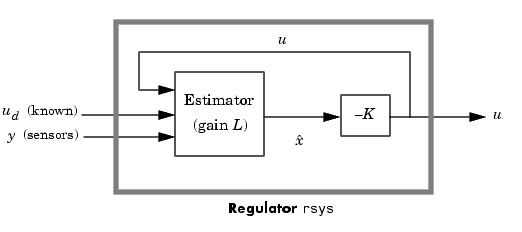
The index vectors sensors, known, and controls specify  ,
,  , and
, and  as subsets of the outputs and inputs of
 sys. The resulting regulator uses  as inputs to generate the commands
  (see figure below).
Example
Given a continuous-time state-space model
sys = ss(A,B,C,D)
with seven outputs and four inputs, suppose you have designed:
K using inputs 1, 2, and 4 of the plant as control inputsL using outputs 4, 7, and 1 of the plant as sensors, and input 3 of the plant as an additional known inputYou can then connect the controller and estimator and form the complete regulation system by
controls = [1,2,4];
sensors = [4,7,1];
known = [3];
regulator = reg(sys,K,L,sensors,known,controls)
See Also
estim
kalman
lqgreg
lqr, dlqr
place
| | pzmap | reshape | |