

| Financial Toolbox | |
Syntax
[U, H] = ugarchsim(Kappa, Alpha, Beta, NumSamples)
Description
[U, H] = ugarchsim(Kappa, Alpha, Beta, NumSamples)
simulates a univariate GARCH(P,Q) process with Gaussian innovations.
U is a number of samples (NUMSAMPLES)-by-1 vector of innovations ( t), representing a mean-zero, discrete-time stochastic process. The innovations time series
 U is designed to follow the GARCH(P,Q) process specified by the inputs Kappa, Alpha, and Beta.
H is a NUMSAMPLES-by-1 vector of the conditional variances ( t2) corresponding to the innovations vector
 U. Note that U and H are the same length, and form a "matching" pair of vectors. As shown in the following equation, t2 (i.e., H(t)) represents the time series inferred from the innovations time series {t} (i.e., U).
The time-conditional variance, t2, of a GARCH(P,Q) process is modeled as
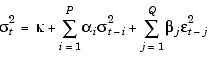
 represents the argument
 Alpha,  represents
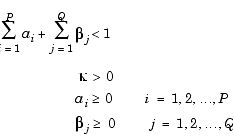
 Beta, and the GARCH(P,Q) coefficients { , , } are subject to the following constraints.
U is a vector of residuals or innovations (t) of an econometric model, representing a mean-zero, discrete-time stochastic process.
Although t2 is generated using the equation above, t and t2 are related as

U and H are designed to be steady-state sequences in which transients have arbitrarily small effect. The (arbitrary) metric used by ugarchsim strips the first N samples of U and H such that the sum of the GARCH coefficients, excluding Kappa, raised to the Nth power, does not exceed 0.01.
0.01 = (sum(Alpha) + sum(Beta))^NThus
N = log(0.01)/log((sum(Alpha) + sum(Beta)))
Note:
ugarchsim corresponds generally to the GARCH Toolbox function
garchsim. The GARCH Toolbox provides a comprehensive and integrated
computing environment for the analysis of volatility in time series. For
information see the GARCH Toolbox User's Guide or the financial products
Web page at http://www.mathworks.com/products/finprod/.
|
Examples
This example simulates a GARCH(P,Q) process with P = 2 and Q = 1.
% Set the random number generator seed for reproducability.

randn('seed', 10)

% Set the simulation parameters of GARCH(P,Q) = GARCH(2,1) process.

Kappa = 0.25;      %a positive scalar.
Alpha = [0.2 0.1]'; %a column vector of nonnegative numbers (P = 2).
Beta = 0.4;        % Q = 1.
NumSamples = 500;  % number of samples to simulate.

% Now simulate the process.

[U , H] = ugarchsim(Kappa, Alpha, Beta, NumSamples);

% Estimate the process parameters.

P = 2;    % Model order P (P = length of Alpha).
Q = 1;    % Model order Q (Q = length of Beta).
[k, a, b] = ugarch(U , P , Q);
disp(' ')
disp(' Estimated Coefficients:')
disp(' -----------------------')
disp([k; a; b])
disp(' ')

% Forecast the conditional variance using the estimated
% coefficients.

NumPeriods = 10;    % Forecast out to 10 periods.
[VarianceForecast, H1] = ugarchpred(U, k, a, b, NumPeriods);
disp(' Variance Forecasts:')
disp(' ------------------')
disp(VarianceForecast)
disp(' ')
When the above code is executed, the screen output looks like the display shown.
%%%%%%%%%%%%%%%%%%%%%%%%%%%%%%%%%%%%%%%%%%%%%%%%%%%%%%%%%%%
Diagnostic Information
Number of variables: 4
Functions
Objective:        ugarchllf
Gradient:         finite-differencing
Hessian:          finite-differencing (or Quasi-Newton)

Constraints
Nonlinear constraints:             do not exist
Number of linear inequality constraints:    1
Number of linear equality constraints:      0
Number of lower bound constraints:          4
Number of upper bound constraints:          0
Algorithm selected
   medium-scale
%%%%%%%%%%%%%%%%%%%%%%%%%%%%%%%%%%%%%%%%%%%%%%%%%%%%%%%%%%%
End diagnostic information
                                max                 Directional
 Iter   F-count    f(x)   constraint   Step-size     derivative     Procedure
    1     5     699.185      -0.125            1      -2.97e+006
    2    22     658.224     -0.1249     0.000488           -64.6
    3    28     610.181           0            1           -49.4
    4    35     590.888           0          0.5           -38.9
    5    42     583.961    -0.03317          0.5           -29.8
    6    49     583.224    -0.02756          0.5           -31.8
    7    57     582.947    -0.02067         0.25           -7.28
    8    63     578.182           0            1           -2.43
    9    71     578.138    -0.09145         0.25           -0.55
   10    77     577.898    -0.04452            1          -0.148
   11    84     577.882    -0.06128          0.5         -0.0488
   12    90     577.859    -0.07117            1       -0.000758
   13    96     577.858    -0.07033            1       -0.000305    Hessian modified
   14   102     577.858    -0.07042            1      -3.32e-005    Hessian modified
   15   108     577.858     -0.0707            1      -1.29e-006    Hessian modified
   16   114     577.858    -0.07077            1      -1.29e-007    Hessian modified
   17   120     577.858    -0.07081            1      -1.97e-007    Hessian modified

Optimization Converged Successfully
Magnitude of directional derivative in search direction
  less than 2*options.TolFun and maximum constraint violation
  is less than options.TolCon
No Active Constraints

Estimated Coefficients:
----------------------
0.2520
0.0708
0.1623
0.4000

Variance Forecasts:
------------------
1.3243
0.9594
0.9186
0.8402
0.7966
0.7634
0.7407
0.7246
0.7133
0.7054
See Also
ugarch, ugarchpred, and the GARCH Toolbox function garchsim
References
James D. Hamilton, Time Series Analysis, Princeton University Press, 1994
| | ugarchpred | weekday | |