| Fixed-Point Blockset | |
This section presents a fixed-point state-space realization. The difference equation, block parameters, and model design are discussed.
The FixPt State-Space Realization block is a masked subsystem that implements the system described by
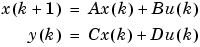
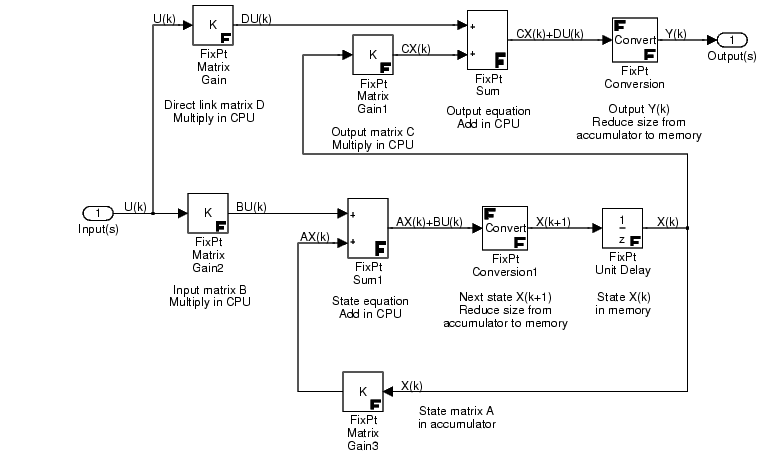
where k is the current time step, k + 1 is the next time step, u(k) is the current input, x(k) is the current state, x(k + 1) is the state from the next time step, y(k) is the current output, and A, B, C, and D are all coefficient matrices. The realization is shown below.
Parameters and Dialog Box
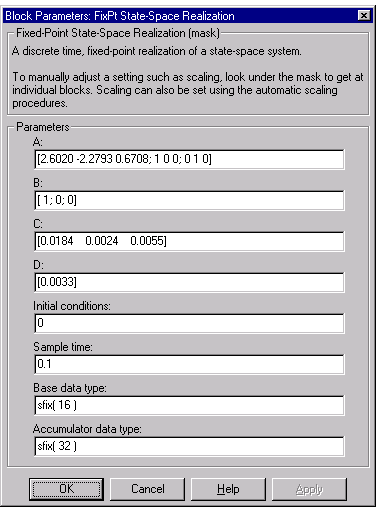
The dialog box and parameter descriptions for the state-space realization are given below.
The advantage of using the state-space realization is that you can build high order systems quickly. The disadvantage is that you can't individually scale the elements on vector signal lines. For example, even if the i-th state, xi, is large and the j-th state, xj, is small, you must use the same scaling for both. Matrix gain coefficients can be individually scaled but this may not suffice.
The solution to this problem is to use a new realization with more blocks and fewer elements on each signal line. For maximum control of scaling, you should use a diagram that has only scalars on each line.
Model Design Review
A brief review of the model design is given below. The design criteria reflect the rules presented in Design Rules.
| | Lead Filter or Lag Filter Realization | Reference | |