| Financial Time Series | |
Syntax
[spctk, spctd] = spctkd(fastpctk, fastpctd)
[spctk, spctd] = spctkd([fastpctk  fastpctd])
[spctk, spctd] = spctkd(fastpctk, fastpctd, dperiods, dmamethod)
[spctk, spctd] = spctkd([fastpctk  fastpctd], dperiods, dmamethod)
skdts = spctkd(tsobj)
skdts = spctkd(tsobj, dperiods, dmamethod)
skdts = spctkd(tsobj, dperiods, dmamethod, ParameterName,
    ParameterValue, ...)
Arguments
Description
[spctk, spctd] = spctkd(fastpctk, fastpctd)
calculates the slow stochastics S%K and S%D. spctk and spctd are column vectors representing the respective slow stochastics.
[spctk, spctd] = spctkd([fastpctk fastpctd])
accepts a two-column matrix as input. The first column contains the fast stochastic F%K values, and the second contains the fast stochastic F%D values.
[spctk, spctd] = spctkd(fastpctk, fastpctd, dperiods, dmamethod)
calculates the slow stochastics, S%K and S%D, using the value of dperiods to set the number of periods and dmamethod to indicate the moving average method. The inputs fastpctk and fastpctk must contain the fast stochastics, F%K and F%D in column orientation. spctk and spctd are column vectors representing the respective slow stochastics.
Valid moving average methods for %D are Exponential ('e') and Triangular ('t'). See tsmovavg for explanations of these methods.
[spctk, spctd] = spctkd([fastpctk fastpctd], dperiods, dmamethod)
accepts a two-column matrix rather than two separate vectors. The first column contains the F%K values, and the second contains the F%D values.
skdts = spctkd(tsobj)
calculates the slow stochastics, S%K and S%D. tsobj must contain the fast stochastics, F%K and F%D, in data series named PercentK and PercentD. skdts is a financial time series object with the same dates as tsobj. Within tsobj the two series SlowPctK and SlowPctD represent the respective slow stochastics.
skdts = spctkd(tsobj, dperiods, dmamethod)
allows you to specify the length and the method of the moving average used to calculate S%D values.
skdts = spctkd(tsobj, dperiods, dmamethod, ParameterName,
ParameterValue, ...) accepts parameter name/parameter value pairs as input. These pairs specify the name(s) for the required data series if it is different from the expected default name(s). Valid parameter names are:
Parameter values are the strings that represent the valid parameter names.
Example
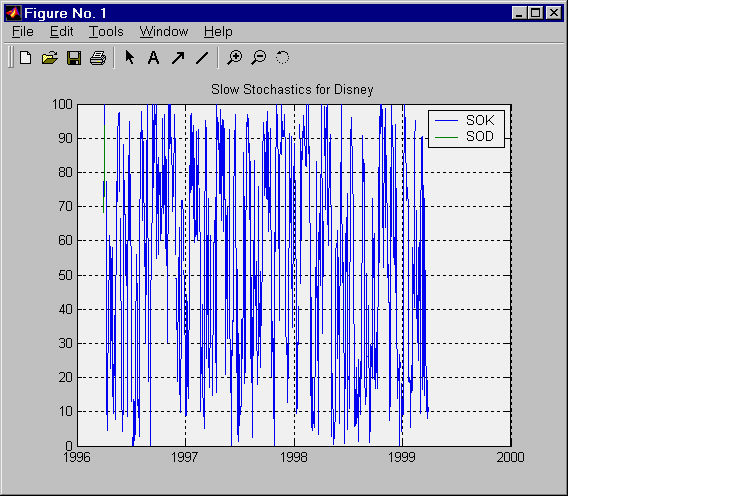
Compute the slow stochastics for Disney stock and plot the results.
load disney.mat
dis_FastStoch = fpctkd(dis);
dis_SlowStoch = spctkd(dis_FastStoch);
plot(dis_SlowStoch)
title('Slow Stochastics for Disney')
See Also
Reference
Achelis, Steven B., Technical Analysis From A To Z, Second Printing, McGraw-Hill, 1995, pg. 268 - 271
| | sortfts | std | |