| Financial Time Series | |
William's Accumulation/Distribution line
Syntax
wadl = willad(highp, lowp, closep)
wadl = willad([highp lowp closep])
wadlts = willad(tsobj)
wadlts = willad(tsobj, ParameterName, ParameterValue, ...)
Arguments
highp |
High price (vector) |
lowp |
Low price (vector) |
|
Closing price (vector) |
tsobj |
Time series object |
Description
wadl = willad(highp, lowp, closep)
computes the William's Accumulation/Distribution line for a set of stock price data. The prices needed for this function are the high (highp), low (lowp), and closing (closep) prices. All three are required.
wadl = willad([highp lowp closep])
accepts a three column matrix of prices as input. The first column contains the high prices, the second contains the low prices, and the third contains the closing prices.
wadlts = willad(tsobj)
computes the William's Accumulation/Distribution line for a set of stock price data contained in the financial time series object tsobj. The object must contain the high, low, and closing prices needed for this function. The function assumes that the series are named High, Low, and Close. All three are required. wadlts is a financial time series object with the same dates as tsobj and a single data series named 'WillAD'.
wadlts = willad(tsobj, ParameterName, ParameterValue, ...)
accepts parameter name/parameter value pairs as input. These pairs specify the name(s) for the required data series if it is different from the expected default name(s). Valid parameter names are:
'HighName': high prices series name'LowName': low prices series name'CloseName': closing prices series nameParameter values are the strings that represent the valid parameter names.
Example
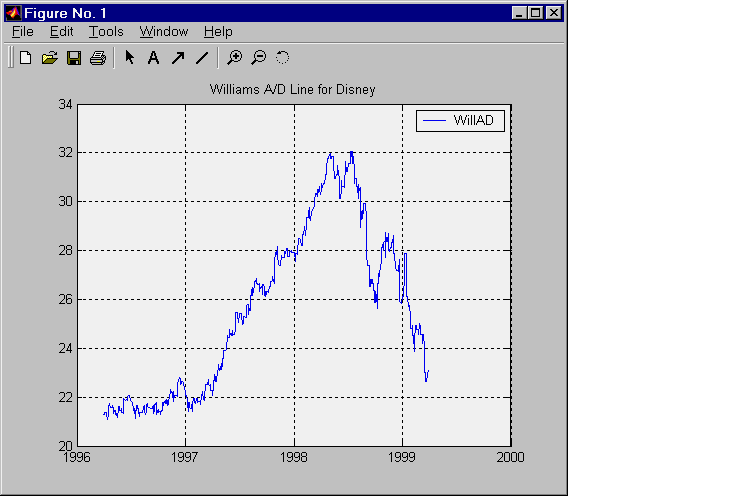
Compute the Williams A/D line for Disney stock and plot the results.
load disney.mat
dis_Willad = willad(dis)
plot(dis_Willad)
title('Williams A/D Line for Disney')
See Also
Reference
Achelis, Steven B., Technical Analysis From A To Z, Second Printing, McGraw-Hill, 1995, pg. 314 - 315
| | wclose | willpctr | |