| GARCH Toolbox | |
Plot or return computed sample cross-correlation function
Syntax
crosscorr(Series1, Series2, nLags, nSTDs)
[XCF, Lags, Bounds] = crosscorr(Series1, Series2, nLags, nSTDs)
Arguments
Series1 |
Vector of observations of the first univariate time series for which crosscorr computes or plots the sample cross-correlation function (XCF). The last element of Series1 contains the most recent observation. |
Series2 |
Vector of observations of the second univariate time series for which crosscorr computes or plots the sample XCF. The last element of Series2 contains the most recent observation. |
nLags |
(optional) Positive, scalar integer indicating the number of lags of the XCF to compute. If nLags = [] or is not specified, crosscorr computes the XCF at lags 0, ±1, ±2, ..., ±T, where T = min([20, min([length(Series1), length(Series2)])-1]). |
nSTDs |
(optional) Positive scalar indicating the number of standard deviations of the sample XCF estimation error to compute, if Series1 and Series2 are uncorrelated. If nSTDs = [] or is not specified, the default is 2 (i.e., approximate 95 percent confidence interval). |
Description
crosscorr(Series1, Series2, nLags, nSTDs)
computes and plots the sample cross-correlation function (XCF) between two univariate, stochastic time series. To plot the XCF sequence without the confidence bounds, set nSTDs = 0.
[XCF, Lags, Bounds] = crosscorr(Series1, Series2, nLags, nSTDs)
computes and returns the XCF sequence.
Example
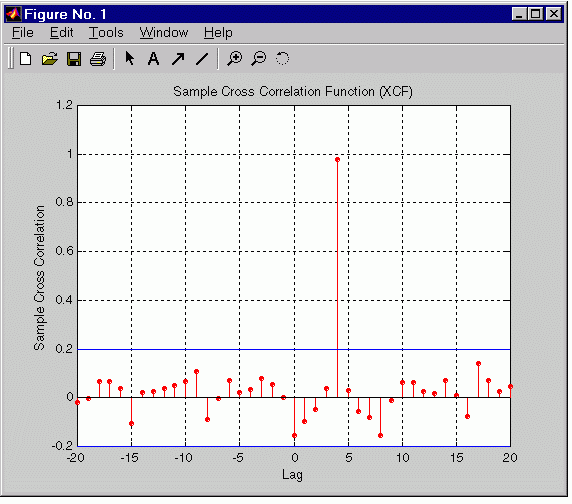
Create a random sequence of 100 Gaussian deviates, and a delayed version lagged by four samples. Compute the XCF, and then plot it to see the XCF peak at the fourth lag.
randn('state',100)              % Start from a known state.
x           = randn(100,1);     % 100 Gaussian deviates, N(0,1).
y           = lagmatrix(x, 4);  % Delay it by 4 samples.
y(isnan(y)) = 0;                % Replace NaNs with zeros.
[XCF, Lags, Bounds] = crosscorr(x,y);  % Compute the XCF with
                                       % 95 percent confidence.
[Lags, XCF]

ans =

  -20.0000   -0.0210
  -19.0000   -0.0041
  -18.0000    0.0661
  -17.0000    0.0668
  -16.0000    0.0380
  -15.0000   -0.1060
  -14.0000    0.0235
  -13.0000    0.0240
  -12.0000    0.0366
  -11.0000    0.0505
  -10.0000    0.0661
   -9.0000    0.1072
   -8.0000   -0.0893
   -7.0000   -0.0018
   -6.0000    0.0730
   -5.0000    0.0204
   -4.0000    0.0352
   -3.0000    0.0792
   -2.0000    0.0550
   -1.0000    0.0004
         0   -0.1556
    1.0000   -0.0959
    2.0000   -0.0479
    3.0000    0.0361
    4.0000    0.9802
    5.0000    0.0304
    6.0000   -0.0566
    7.0000   -0.0793
    8.0000   -0.1557
    9.0000   -0.0128
   10.0000    0.0623
   11.0000    0.0625
   12.0000    0.0268
   13.0000    0.0158
   14.0000    0.0709
   15.0000    0.0102
   16.0000   -0.0769
   17.0000    0.1410
   18.0000    0.0714
   19.0000    0.0272
   20.0000    0.0473

Bounds =

    0.2000
   -0.2000

crosscorr(x,y)         % Use the same example, but plot the XCF
                       % sequence. Note the peak at the 4th lag.
filter (in the online MATLAB Function Reference)
| | autocorr | garchar | |