

| GARCH Toolbox | |
Ljung-Box Q-statistic lack-of-fit hypothesis test
Syntax
[H, pValue, Qstat, CriticalValue] = lbqtest(Series, Lags, Alpha,
DoF)
Arguments
Series |
Vector of observations of a univariate time series for which lbqtest computes the sample Q-statistic. The last row of Series contains the most recent observation of the stochastic sequence. Typically, Series is either the sample residuals derived from fitting a model to an observed time series, or the standardized residuals obtained by dividing the sample residuals by the conditional standard deviations. |
Lags |
(optional) Vector of positive integers indicating the lags of the sample autocorrelation function included in the Q-statistic. If specified, each lag must be less than the length of Series. If Lags = [] or is not specified, the default is Lags = min([20, length(Series)-1]). |
Alpha |
(optional) Significance level(s). Alpha can be a scalar applied to all lags, or a vector the same length as Lags. If Alpha = [] or is not specified, the default is 0.05. For all elements,  , of , of Alpha, 0 < < 1. |
DoF |
(optional) Degree(s) of freedom. DoF can be a scalar applied to all lags, or a vector the same length as Lags. If specified, all elements of DoF must be positive integers less than the corresponding element of Lags. If DoF = [] or is not specified, the elements of Lags serve as the default degrees of freedom for the Chi-Square distribution. |
Description
[H, pValue, Qstat, CriticalValue] = lbqtest(Series, Lags, Alpha,
DoF)
performs the Ljung-Box lack-of-fit hypothesis test for model misspecification, which is based on the Q-statistic
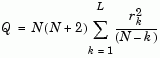
where N = sample size, L = number of autocorrelation lags included in the statistic, and rk2 is the squared sample autocorrelation at lag k. Once you fit a univariate model to an observed time series, you can use the Q-statistic as a lack-of-fit test for a departure from randomness. Under the null hypothesis that the model fit is adequate, the test statistic is asymptotically Chi-Square distributed.
Example
Create a vector of 100 Gaussian random numbers, then compute the Q-statistic for autocorrelation lags 20 and 25 at the 10 percent significance level.
randn('state',100)               % Start from a known state.
Series         = randn(100,1);   % 100 Gaussian deviates ~ N(0,1)
[H,P,Qstat,CV] = lbqtest(Series, [20 25]', 0.10);
[H,P,Qstat,CV]

ans =

         0    0.9615   10.3416   28.4120
         0    0.9857   12.1015   34.3816
Reference
Box, G.E.P., G.M. Jenkins, G.C. Reinsel, Time Series Analysis: Forecasting and Control, third edition, Prentice Hall, 1994.
Gourieroux, C., ARCH Models and Financial Applications, Springer-Verlag, 1997.
| | lagmatrix | lratiotest | |