

| System Identification | |
Syntax
pzmap(m)
pzmap(m,'sd',sd)
pzmap(m1,m2,m3,...)
pzmap(m1,'PlotStyle1',m2,'PlotStyle2',...,'sd',sd)
pzmap(m1,m2,m3,..,'sd',sd,mode,axis)
Description
m is any idmodel object: idarx, idgrey, idss, or idpoly.
The zeros and poles of m are graphed, with o denoting zeros and x denoting poles. Poles and zeros at infinity are ignored. For discrete-time models, zeros and poles at the origin are also ignored.
If sd has a value larger than zero, confidence regions around the poles and zeros are also graphed. The regions corresponding to sd standard deviations are marked. The default value is sd = 0. Note that the confidence regions may sometimes stretch outside the plot, but they are always symmetric around the indicated zero or pole.
If the poles and zeros are associated with a discrete-time model, a unit circle is also drawn. For continuous-time models the real and imaginary axes are drawn
When mi contain information about several different input/output channels, there are some options:
mode = 'sub' splits the screen into several plots, one for each input/output channel. These are based on the InputName and OutputName properties associated with the different models.
mode = 'same' gives all plots in the same diagram. Pressing the Return key advances the plots.
mode = 'sep' erases the previous plot before the next channel pair is treated.
The default value is mode = 'sub'.
axis = [x1 x2 y1 y2] fixes the axis scaling accordingly. axis = s is the same as
axis = [-s s -s s]
The colors associated with the different models can be selected by the arguments PlotStyle. Use PlotStyle = 'b', 'g', etc. Markers and line styles are not used.
The noise input channels in m are treated as follows: Consider a model m with both measured input channels u (nu channels) and noise channels e (ny channels) with covariance matrix 
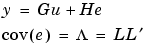
where L is a lower triangular matrix. Note that m.NoiseVariance =  . The model can also be described with unit variance, normalized noise source v:
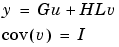
pzmap(m) plots the zeros and poles of the transfer function G.pzmap(m('n')) plots the zeros and poles of the transfer function H. (ny inputs and ny outputs). The input channels have names e@yname, where yname is the name of the corresponding output.m is a time series, that is nu = 0, pzmap(m) plots the zeros and poles of the the transfer function H.pzmap(noisecnv(m)) plots the zeros and poles of the transfer function [G H] (nu+ny inputs and ny outputs). The noise input channels have names e@yname, where yname is the name of the corresponding output.pzmap(noisecnv(m,'norm'))lots the zeros and poles of the transfer function [G HL] (nu+ny inputs and ny outputs. The noise input channels have names v@yname, where yname is the name of the corresponding output. Examples
mbj = bj(data,[2 2 1 1 1]);
mar = armax(data,[2 2 2 1]);
pzmap(mbj,mar,'sd',3)
shows all zeros and poles of two models along with the confidence regions corresponding to three standard deviations.
See Also
| | present | rarmax | |