| Image Processing Toolbox | |
Syntax
R = radon(I,theta)
R = radon(I,theta,n)
[R,xp] = radon(...)
Description
The radon function computes the Radon transform, which is the projection of the image intensity along a radial line oriented at a specified angle.
R = radon(I,theta) returns the Radon transform of the intensity image I for the angle theta degrees. If theta is a scalar, the result R is a column vector containing the Radon transform for theta degrees. If theta is a vector, then R is a matrix in which each column is the Radon transform for one of the angles in theta. If you omit theta, it defaults to 0:179.
R = radon(I,theta,n) returns a Radon transform with the projection computed at n points. R has n rows. If you do not specify n, the number of points at which the projection is computed is
2*ceil(norm(size(I)-floor((size(I)-1)/2)-1))+3
This number is sufficient to compute the projection at unit intervals, even along the diagonal.
[R,xp] = radon(...) returns a vector xp containing the radial coordinates corresponding to each row of R.
Class Support
I can be of class double or of any integer class. All other inputs and outputs are of class double.
Remarks
The radial coordinates returned in xp are the values along the x'-axis, which is oriented at theta degrees counterclockwise from the x-axis. The origin of both axes is the center pixel of the image, which is defined as
floor((size(I)+1)/2)
For example, in a 20-by-30 image, the center pixel is (10,15).
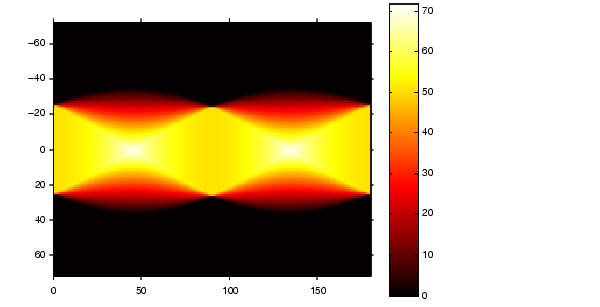
Example
iptsetpref('ImshowAxesVisible','on')
I = zeros(100,100);
I(25:75,25:75) = 1;
theta = 0:180;
[R,xp] = radon(I,theta);
imshow(theta,xp,R,[],'notruesize'), colormap(hot), colorbar
See Also
References
Bracewell, Ronald N. Two-Dimensional Imaging. Englewood Cliffs, NJ: Prentice Hall, 1995. pp. 505-537.
Lim, Jae S. Two-Dimensional Signal and Image Processing. Englewood Cliffs, NJ: Prentice Hall, 1990. pp. 42-45.
| | qtsetblk | rgb2gray | |