| Model Predictive Control Toolbox | |
The MPC mod format is a compact way to store the model of a linear system for subsequent use in the MPC Toolbox functions.
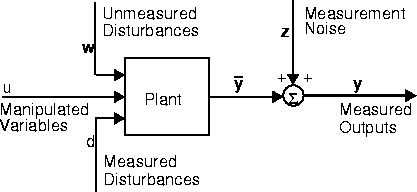
Consider the process shown in the above block diagram. Its discrete-time LTI state-space representation is:
 where x is a vector of n state variables, u represents the nu manipulated variables, d represents nd measured but freely-varying inputs (i.e., measured disturbances), w represents nw unmeasured disturbances, y is a vector of ny plant outputs, z is measurement noise, and
  ,
,  u, etc., are constant matrices of appropriate size. The variable
  (k) represents the plant output before the addition of measurement noise. Define:
= [u d w]
D = [Du Dud Dw]
In some cases one would like to include nym measured and nyu unmeasured outputs in y, where nym + nyu = ny. If so, the mod format assumes that the y vector and the C and D matrices are arranged such that the measured outputs come first, followed by the unmeasured outputs.
The mod format is a single matrix that contains the, , C, and D matrices, plus some additional information. Let M be the mod representation of the above system. Its overall dimensions are:
minfo vector is the first seven elements of the first row in M. The elements of minfo are:Notes
Since the minfo vector requires seven columns, this is the minimum possible number of columns in the mod format, regardless of the dimensions of the state-space matrices.
mpcinfo routine to recognize matrices in the MPC mod format, the (2,1) element is set to NaN (Not-a-Number).
Example
See ss2mod for a mod format example.
See Also
mod2ss, mod2step, step format, mpcinfo, ss2mod, step, tfd2mod, tf format, th2mod, theta format
| mlr | mod2frsp, varying format | |