| Model Predictive Control Toolbox | |
Combines a plant model and a controller model in the MPC mod format, yielding a closed-loop system model in the MPC format. This can be used for stability analysis and linear simulations of closed-loop performance.
Syntax
[clmod,cmod] =smpccl(pmod,imod,Ks) [clmod,cmod] =smpccl(pmod,imod,Ks,Kest)
pmod
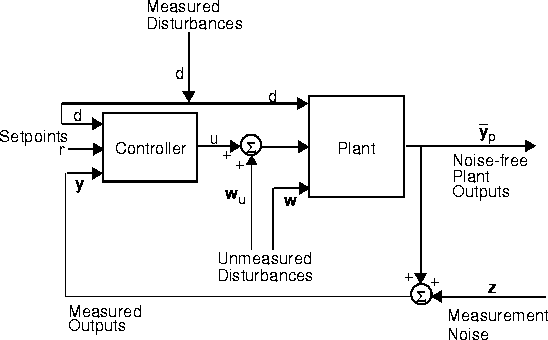
Is a model (in the mod format) representing the plant in the above diagram.
imod
Is a model (in the same format) that is to be used to design the MPC controller block shown in the diagram. It may be the same as pmod (in which case there is no model error in the controller design), or it may be different.
Ks
Is a controller gain matrix, which must have been calculated by the function smpccon.
Kest
Is an (optional) estimator gain matrix. If omitted or set to an empty matrix, the default is to use the DMC estimator index DMC estimator. See the documentation for the function smpcest for more details on the design and proper format of Kest.
smpccl
Calculates a model of the closed-loop system, clmod. It is in the mod format and can be used, for example, with analysis functions such as smpcgain and smpcpole, and with simulation routines such as mod2step and dlsimm. smpccl also calculates a model of the controller element, cmod.
clmod, has the following state-space representation:
xcl(k + 1) =  clxcl(k) +
  clucl(k)
ycl(k) = Cclxcl(k) + D clucl(k)
where xcl is a vector of n state variables, ucl is a vector of input variables, ycl is a vector of outputs, and cl, cl, Ccl, and Dcl are matrices of appropriate size. The expert user may want to know the significance of the state variables in xcl. They are (in the following order):
pmod),
imod and the estimator gain, Kest),
 (from the state estimator),
 u signal produced by the standard MPC formulation to yield a u signal that can be used as input to the plant and as a closed-loop output, and
d signal required in the standard MPC formulation. If there are no measured disturbances, these states are omitted.
u signal produced by the standard MPC formulation to yield a u signal that can be used as input to the plant and as a closed-loop output, and
d signal required in the standard MPC formulation. If there are no measured disturbances, these states are omitted.
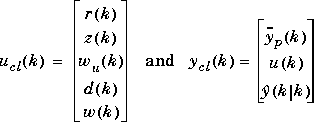
 is the estimate of the noise-free plant output at sampling period k based on information available at period k. This estimate is generated by the controller element.
Note that ucl will include d and/or w automatically whenever
is the estimate of the noise-free plant output at sampling period k based on information available at period k. This estimate is generated by the controller element.
Note that ucl will include d and/or w automatically whenever pmod includes measured disturbances and/or unmeasured disturbances. Thus the length of the ucl vector will depend on the inputs you have defined in pmod and imod. Similarly, ycl depends on the number of outputs and manipulated variables. Let m and p be the lengths of ucl and ycl, respectively. Then
cmod, can be written as:
xc(k + 1) = cxc(k) + cluc(k)
yc(k) = Ccxc(k) + D cuc(k)
where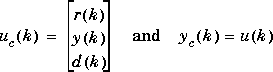
Examples
Consider the linear system:
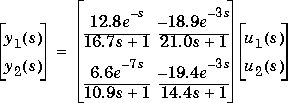
poly2tfd and tfd2mod.
g11=poly2tfd(12.8,[16.7 1],0,1);
g21=poly2tfd(6.6,[10.9 1],0,7);
g12=poly2tfd(-18.9,[21.0 1],0,3);
g22=poly2tfd(-19.4,[14.4 1],0,3);
delt=3; ny=2;
imod=tfd2mod(delt,ny,g11,g21,g12,g22);
pmod=imod; % No plant/model mismatch
Now we design the controller. Since there is delay, we use
M < P: We specify the defaults for the other tuning parameters, uwt and ywt, then calculate the controller gain:
P=6; % Prediction horizon. M=2; % Number of moves (input horizon).Now we can calculate the model of the closed-loop system and check its poles for stability:ywt=[ ]; % Output weights (default - unity on % all outputs).uwt=[ ]; % Man. Var weights (default - zero on % all man. vars).Ks=smpccon(imod,ywt,uwt,M,P);
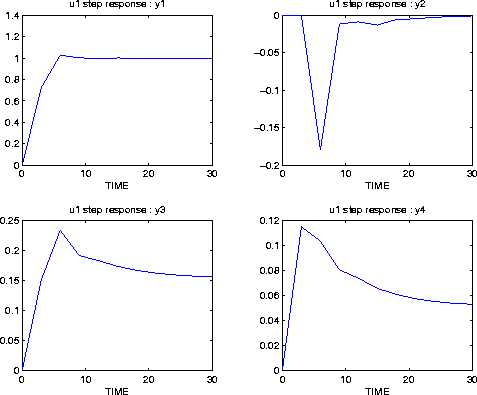
clmod=smpccl(pmod,imod,Ks); maxpole=max(abs(The result is:smpcpole(clmod)))
maxpole = 0.8869Since this is less than 1, the plant and controller combination will be closed-loop stable. (The closed-loop system has 20 states in this example). You can also use the closed-loop model to calculate and plot the step response with respect to all the inputs. The appropriate commands are:
tend=30;
clstep=mod2step(clmod,tend);
plotstep(clstep)
Since the closed-loop system has m = 6 inputs and p = 6 outputs, only one of the plots is reproduced here. It shows the response of the first 4 closed-loop outputs to a step in the first closed-loop input, which is the setpoint for y1:
dlsimm to calculate the response of the closed-loop system to a step in the setpoint for y1, with added random measurement noise.
r=[ones(11,1) zeros(11,1)];
z=0.1*rand(11,2);
wu=zeros(11,2);
d=[ ];
w=[ ];
ucl=[r z wu d w];
[phicl,gamcl,ccl,dcl]=mod2ss(clmods);
ycl=dlsimm(phicl,gamcl,ccl,dcl,ucl);
y=ycl(:,1:2); u=ycl(:,3:4); ym=ycl(:,5:6);
Restrictions
imod and pmod must have been created using the same sampling period, and an equal number of outputs, measured disturbances, and manipulated variables.
imod and pmod must be strictly proper, i.e., the D matrices in their state-space descriptions must be zero. Exception: the last nw columns of the D matrices may be nonzero, i.e., the unmeasured disturbance may have an immediate effect on the outputs.
See Also
mod2step, scmpc, smpccon, smpcest, smpcgain, smpcpole, smpcsim
| sermod | smpccon | |