

| Optimization Toolbox | |
Nonlinear Inequality Constrained Example
If inequality constraints are added to Eq. 1-1, the resulting problem may be solved by the fmincon function. For example, find x that solves

|
(1-2) |
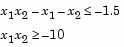
Since neither of the constraints is linear, you cannot pass the constraints to fmincon at the command line. Instead you can create a second M-file confun.m that returns the value at both constraints at the current x in a vector c. The constrained optimizer, fmincon, is then invoked. Because fmincon expects the constraints to be written in the form  , you must rewrite your constraints in the form
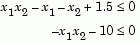
|
(1-3) |
Step 1: Write an M-file confun.m for the constraints
function [c, ceq] = confun(x)
% Nonlinear inequality constraints
c = [1.5 + x(1)*x(2) - x(1) - x(2);
     -x(1)*x(2) - 10];
% Nonlinear equality constraints
ceq = [];
Step 2: Invoke constrained optimization routine
x0 = [-1,1];   % Make a starting guess at the solution
options = optimset('LargeScale','off');
[x, fval] = ...
fmincon(@objfun,x0,[],[],[],[],[],[],@confun,options)
After 38 function calls, the solution x produced with function value fval is
x =
   -9.5474  1.0474
fval =
    0.0236
We can evaluate the constraints at the solution
[c,ceq] = confun(x)
c=
    1.0e-15 *
   -0.8882
    0

ceq =
     []
Note that both constraint values are less than or equal to zero, that is, x satisfies  .
.
| | Unconstrained Example | Constrained Example with Bounds | |