| Target Language Compiler | |
The target language function construct is
%function identifier ( optional-arguments ) [Output | void]
%return
%endfunction
Functions in the target language are recursive and have their own local variable space. Target language functions do not produce any output, unless they explicitly use the %openfile, %selectfile, and %closefile directives, or are output functions.
A function optionally returns a value with the %return directive. The returned value can be any of the types defined in the Target Language Values table.
In this example, a function, name, returns x, if x and y are equal, and returns z, if x and y are not equal.
%function name(x,y,z) void

%if x == y
   %return x
%else
   %return z
%endif

%endfunction
Function calls can appear in any context where variables are allowed.
All %with statements that are in effect when a function is called are available to the function. Calls to other functions do not include the local scope of the function, but do include any %with statements appearing within the function.
Assignments to variables within a function always create new, local variables and can not change the value of global variables unless you use the :: scope resolution operator.
By default, a function returns a value and does not produce any output. You can override this behavior by specifying the Output and void modifiers on the function declaration line, as in
%function foo() Output
...
%endfunction
In this case, the function continues to produce output to the currently open file, if any, and is not required to return a value. You can use the void modifier to indicate that the function does not return a value, and should not produce any output, as in
%function foo() void
...
%endfunction
Variable Scoping Within Functions
Within a function, the left-hand member of any %assign statement defaults to create a new entry in the function's block within the scope chain, and does not affect any of the other entries. That is, it is local to the function. For example,
%function foo (x,y)
%assign local = 3
%endfunction
adds local = 3 to the foo( ) block in the scope list giving
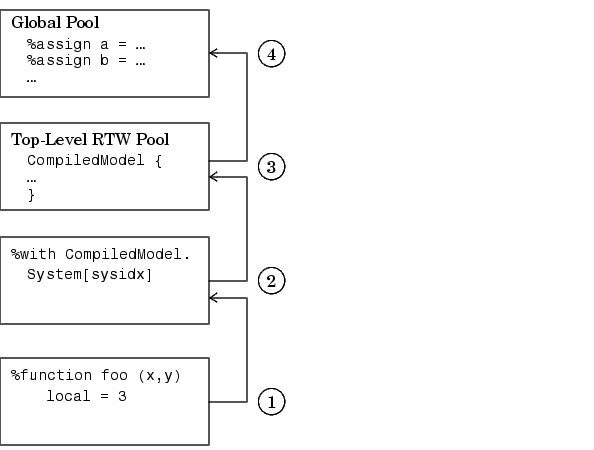
Figure 5-7: Scoping Rules Within Functions Containing Local Variables
You can override this default behavior by using %assign with the :: operator. For example,
%assign ::global = 3
makes global a global variable and initializes it to 3.
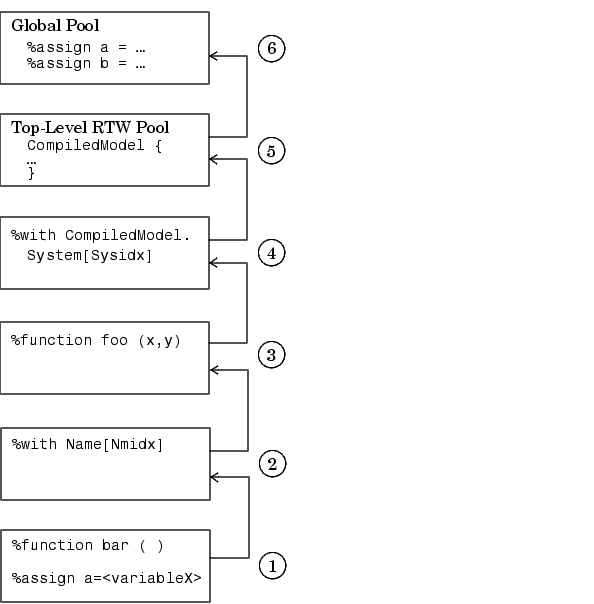
When you introduce new scopes within a function using %with, these new scopes are used during nested function calls, but the local scope for the function is not searched. Also, if a %with is included within a function, its associated scope is carried with any nested function call.
Figure 5-8: Scoping Rules When Using %with Within a Function
%return
The %return statement closes all %with statements appearing within the current function. In this example, the %with statement is automatically closed when the %return statement is encountered, removing the scope from the list of searched scopes.
%function foo(s)
    %with s
        %return(name)
    %endwith
%endfunction
The %return statement does not require a value. You can use %return to return from a function with no return value.
| | Scoping | Command Line Arguments | |