| Signal Processing Toolbox | |
Frequency Response
The Signal Processing Toolbox enables you to perform frequency domain analysis of both analog and digital filters.
Digital Domain
freqz uses an FFT-based algorithm to calculate the z-transform frequency response of a digital filter. Specifically, the statement
[h,w] = freqz(b,a,n)
returns the n-point complex frequency response,  , of the digital filter.

In its simplest form, freqz accepts the filter coefficient vectors b and a, and an integer n specifying the number of points at which to calculate the frequency response. freqz returns the complex frequency response in vector h, and the actual frequency points in vector w in rad/s.
freqz can accept other parameters, such as a sampling frequency or a vector of arbitrary frequency points. The example below finds the 256-point frequency response for a 12th-order Chebyshev type I filter. The call to freqz specifies a sampling frequency fs of 1000 Hz.
[b,a] = cheby1(12,0.5,200/500);
[h,f] = freqz(b,a,256,1000);
Because the parameter list includes a sampling frequency, freqz returns a vector f that contains the 256 frequency points between 0 and fs/2 used in the frequency response calculation.
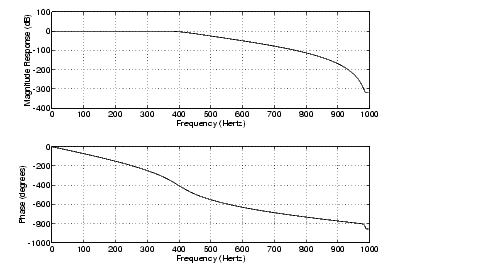
If you call freqz with no output arguments, it automatically plots both magnitude versus frequency and phase versus frequency. For example, a ninth-order Butterworth lowpass filter with a cutoff frequency of 400 Hz, based on a 2000 Hz sampling frequency, is
[b,a] = butter(9,400/1000);
Now calculate the 256-point complex frequency response for this filter, and plot the magnitude and phase with a call to freqz.
freqz(b,a,256,2000)
freqz can also accept a vector of arbitrary frequency points for use in the frequency response calculation. For example,
w = linspace(0,pi);
h = freqz(b,a,w);
calculates the complex frequency response at the frequency points in w for the filter defined by vectors b and a. The frequency points can range from 0 to  . To specify a frequency vector that ranges from zero to your sampling frequency, include both the frequency vector and the sampling frequency value in the parameter list.
| | Impulse Response | Analog Domain | |
 . To convert normalized frequency back to hertz, multiply by half the sample frequency.