

| Signal Processing Toolbox | |
Convert a prediction filter polynomial to reflection coefficients.
Syntax
k=poly2rc(a) [k,r0]=poly2rc(a,efinal)
Description
k converts the prediction filter polynomial = poly2rc(a)
a to the reflection coefficients of the corresponding lattice structure. a can be real or complex, and a(1) cannot be 0. If a(1) is not equal to 1, poly2rc normalizes the prediction filter polynomial by a(1). k is a row vector of size length(a)-1.
[k,r0] returns the zero-lag autocorrelation, = poly2rc(a,efinal)
r0, based on the final prediction error, efinal.
A simple, fast way to check if a has all of its roots inside the unit circle is to check if each of the elements of k has magnitude less than 1.
stable = all(abs(poly2rc(a))<1)
Examples
a=[1.0000 0.6149 0.9899 0.0000 0.0031 -0.0082]; efinal = 0.2; [k,r0]=poly2rc(a,efinal) k = 0.3090 0.9801 0.0031 0.0081 -0.0082 r0 = 5.6032
Limitations
If abs(k(i)) == 1 for any i, finding the reflection coefficients is an ill-conditioned problem. poly2rc returns some NaNs and provide a warning message in this case.
Algorithm
poly2rc implements the recursive relationship
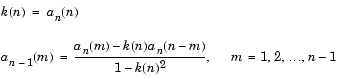
This relationship is based on Levinson's recursion [1]. To implement it, poly2rc loops through a in reverse order after discarding its first element. For each loop iteration i, the function:
k(i) equal to a(i)
i of the vector a.
a = (a-k(i)*fliplr(a))/(1-k(i)^2);
See Also
|
Convert an autocorrelation sequence to reflection coefficients. |
|
Convert a lattice filter parameters to transfer function form. |
|
Lattice and lattice-ladder filter implementation. |
|
Convert a prediction filter polynomial to an autocorrelation sequence. |
|
Convert reflection coefficients to a prediction filter polynomial. |
|
Convert transfer function filter parameters to lattice filter form. |
References
[1] Kay, S.M. Modern Spectral Estimation, Englewood Cliffs, NJ, Prentice-Hall, 1988.
| | poly2lsf | polyscale | |