

| Stateflow | |
Debugging Conflicting Transitions
A transition conflict exists if, at any step in the simulation, there are two equally valid transition paths from the same source. In the case of a conflict, equivalent transitions (based on their labels) are evaluated based on the geometry of the outgoing transitions. See Execution Order for more information.
Detecting Conflicting Transitions
To detect conflicting transitions during a simulation:
Example: Conflicting Transition
This Stateflow diagram has a conflicting transition.
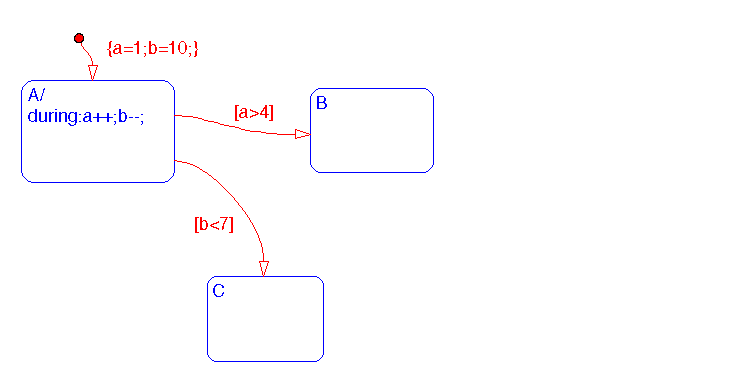
The default transition to state A assigns data a equal to 1 and data b equal to 10. State A's during action increments a and decrements b. The transition from state A to state B is valid if the condition [a > 4] is true. The transition from state A to state C is valid if the condition [b < 7] is true. As the simulation proceeds, there is a point where state A is active and both conditions are true. This is a transition conflict.
Multiple outgoing transitions from states that are of equivalent label priority are evaluated in a clockwise progression starting from the twelve o'clock position on the state. In this example, the transition from state A to state B is taken.
Although the geometry is used to continue after the transition conflict, it is not recommended to design your Stateflow diagram based on an expected execution order.
| | Debugging State Inconsistencies | Debugging Data Range Violations | |