

| Stateflow | |
History Junctions
A history junction is used to represent historical decision points in the Stateflow diagram. The decision points are based on historical data relative to state activity. Placing a history junction in a superstate indicates that historical state activity information is used to determine the next state to become active. The history junction applies only to the level of the hierarchy in which it appears.
Example: Use of History Junctions
This example shows a use of history junctions.
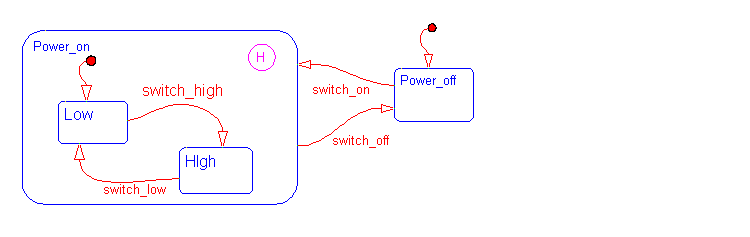
Superstate Power_on has a history junction and contains two substates. If state Power_off is active and event switch_on occurs, the system could enter either Power_on.Low or Power_on.High. The first time superstate Power_on is entered, substate Power_on.Low will be entered because it has a default transition. At some point afterwards, if state Power_on.High is active and event switch_off occurs, superstate Power_on is exited and state Power_off becomes active. Then event switch_on occurs. Since Power_on.High was the last active state, it becomes active again. After the first time Power_on becomes active, the choice between entering Power_on.Low or Power_on.High is determined by the history junction.
See Example: Default Transition and a History Junction for more information on the semantics of this notation.
| | Connective Junctions | History Junctions and Inner Transitions | |