| Wavelet Toolbox | |
Discrete stationary wavelet transform 2-D.
Syntax
SWC = swt2(X,N,'wname')
[A,H,V,D] = swt2(X,N,'wname')
SWC = swt2(X,N,Lo_D,Hi_D)
[A,H,V,D] = swt2(X,N,Lo_D,Hi_D)
Description
swt2 performs a multilevel 2-D stationary wavelet decomposition using either a specific orthogonal wavelet ('wname' see wfilters for more information) or specific orthogonal wavelet decomposition filters.
SWC = swt2(X,N,'wname') or [A,H,V,D] = swt2(X,N,'wname') compute the stationary wavelet decomposition of the matrix X at level N, using 'wname'.
N must be a strictly positive integer (see wmaxlev for more information), and 2N must divide size(X,1) and size(X,2).
Outputs [A,H,V,D] are 3-D arrays, which contain the coefficients:
for 1 
i N, the output matrix A(:,:,i) contains the coefficients of approximation of level i.
The output matrices H(:,:,i), V(:,:,i) and D(:,:,i) contain the coefficients of details of level i (Horizontal, Vertical and Diagonal):
SWC = [H(:,:,1:N) ; V(:,:,1:N) ; D(:,:,1:N) ; A(:,:,N)]
SWC = swt2(X,N,Lo_D,Hi_D) or [A,H,V,D] = swt2(X,N,Lo_D,Hi_D), computes the stationary wavelet decomposition as above, given these filters as input:
Lo_D is the decomposition low-pass filter.Hi_D is the decomposition high-pass filter.Lo_D and Hi_D must be the same length.
Examples
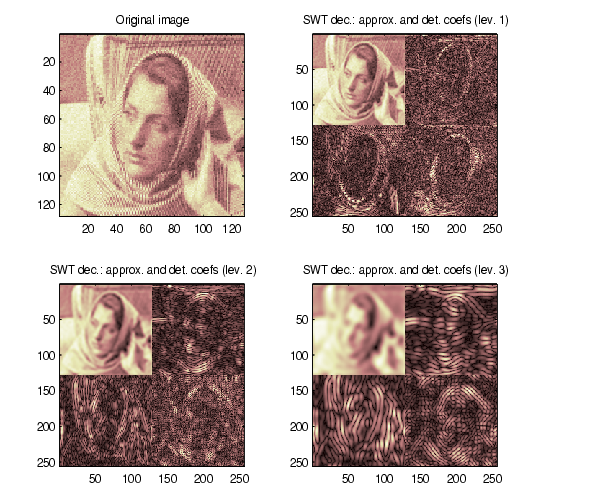
% Load original image.
load nbarb1;

% Image coding.
nbcol = size(map,1);
cod_X = wcodemat(X,nbcol);

% Visualize the original image.
subplot(221)
image(cod_X)
title('Original image');
colormap(map)

% Perform SWT decomposition
% of X at level 3 using sym4.
[ca,chd,cvd,cdd] = swt2(X,3,'sym4');

% Visualize the decomposition.

for k = 1:3
    % Images coding for level k.
    cod_ca  = wcodemat(ca(:,:,k),nbcol);
    cod_chd = wcodemat(chd(:,:,k),nbcol);
    cod_cvd = wcodemat(cvd(:,:,k),nbcol);
    cod_cdd = wcodemat(cdd(:,:,k),nbcol);
    decl = [cod_ca,cod_chd;cod_cvd,cod_cdd];

    % Visualize the coefficients of the decomposition
    % at level k.
    subplot(2,2,k+1)
    image(decl)
    title(['SWT dec.: approx. ', ...
   'and det. coefs (lev. ',num2str(k),')']);
    colormap(map)
end

% Editing some graphical properties,
% the following figure is generated.
Algorithm
For images, an algorithm similar to the one-dimensional case is possible for two-dimensional wavelets and scaling functions obtained from one-dimensional ones by tensor product.
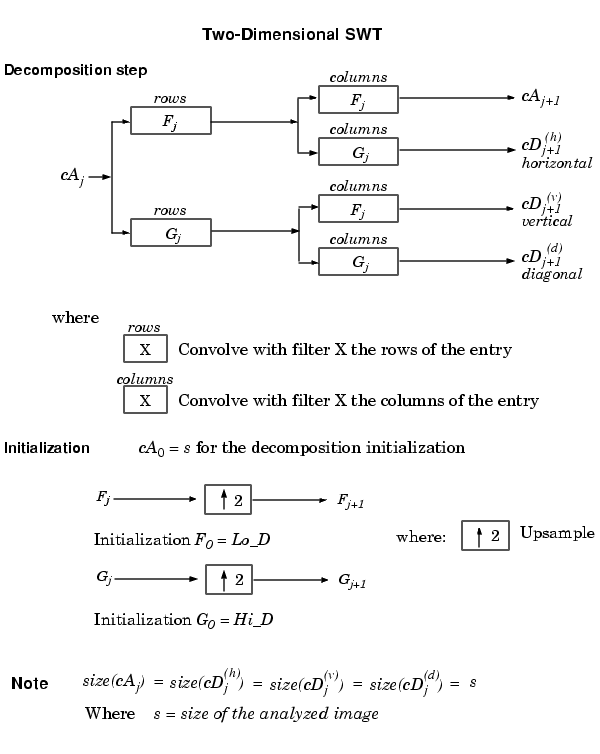
This kind of two-dimensional SWT leads to a decomposition of approximation coefficients at level j in four components: the approximation at level j+1, and the details in three orientations (horizontal, vertical, and diagonal).
The following chart describes the basic decomposition step for images:
References
Nason, G.P.; B.W. Silverman (1995), "The stationary wavelet transform and some statistical applications," Lecture Notes in Statistics, 103, pp. 281-299.
Coifman, R.R.; Donoho D.L. (1995), "Translation invariant de-noising," Lecture Notes in Statistics, 103, pp. 125-150.
Pesquet, J.C.; H. Krim, H. Carfatan (1996), "Time-invariant orthonormal wavelet representations," IEEE Trans. Sign. Proc., vol. 44, 8, pp. 1964-1970.
| | swt | symaux | |