Fig. 1. Sol average pressure plots for Lander 1 for 3.3 Mars years, and Lander 2. The lower frame contains sol average pressure for Lander 1, lower curve, and Lander 2, the upper curve: time is given in sols after landing of Lander 1. The pressure difference between the Landers is mainly due to their elevation difference. In this and all following plots, data are not plotted for sols with greater than 6 hour gaps. The labeling along the top gives the aerocentric longitude, LS, where summer in the northern hemisphere is at LS=90. Perihelion is indicated along the bottom axis of the lower frame with a wide tick mark and is labelled ``P''. The upper frame displays the pressure standard deviation around the sol mean for Lander 1. The transient events are labeled ``T'' while the global or great dust storms are labeled ``S''.
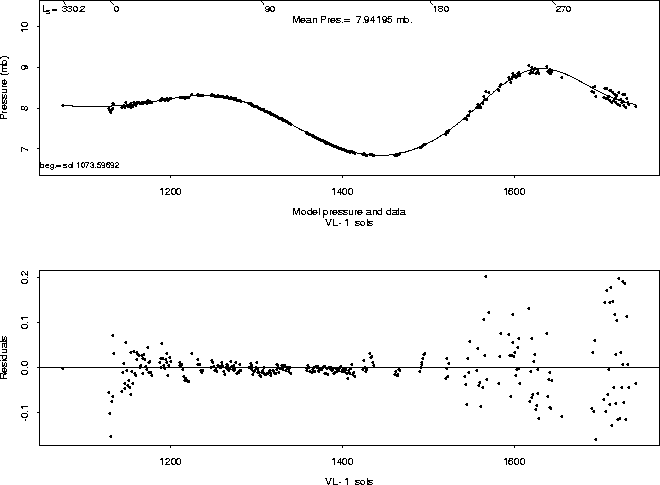
Fig. 2. Sol average and spectral model pressure at Lander 1 for first year without a great dust storm: the year is defined as beginning at sol 405,
 .
(a) Sol average atmospheric pressure in millibars at
Viking Lander 1 (dots) and spectral model pressure (solid line).
Spectral model consists of mean, fundamental and first four harmonics
of the annual cycle as calculated with a weighted least squares fit.
(b) Residual pressure formed by subtracting the spectral model
pressure from the sol average pressure.
.
(a) Sol average atmospheric pressure in millibars at
Viking Lander 1 (dots) and spectral model pressure (solid line).
Spectral model consists of mean, fundamental and first four harmonics
of the annual cycle as calculated with a weighted least squares fit.
(b) Residual pressure formed by subtracting the spectral model
pressure from the sol average pressure.
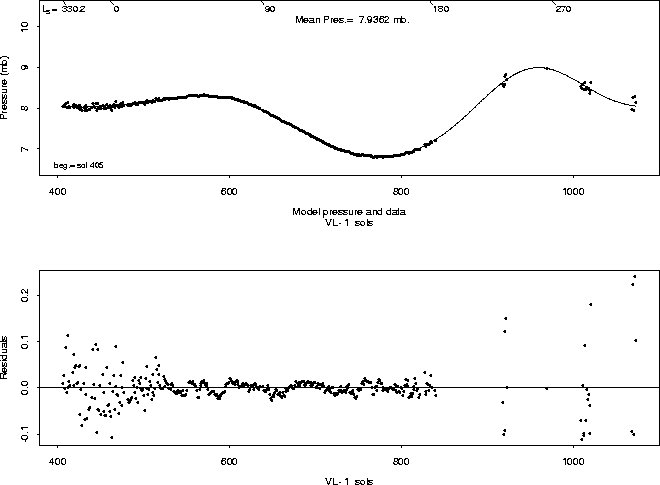
Fig. 3. Sol average, spectral model and residual pressures for the following year at Lander 1. Both panels are the same as those in Figure 2. The model weighting function used was identical to that used for the previous year.
Fig. 4. Comparisons of interannual mean, fundamental and harmonic amplitudes and phases of the Mars annual
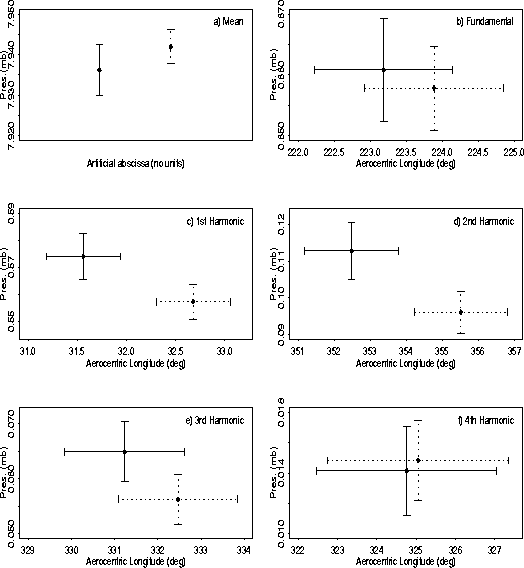
 condensation-sublimation cycle. Standard deviations around the values
are shown by the length of the surrounding bar in both the LS and
amplitude directions. A dashed line is used for the year 2 values.
LS sigmas are obtained by first computing
the sol numbers corresponding to plus and minus 1 sigma from the
nominal value, then computing the LS of those sols, and finally
computing the absolute value of the difference of these LS values
and dividing by 2. Equal sigmas in terms of sols will
not produce equal sigmas in terms of LS throughout the year. Note
that Figure 4a is a comparison of the means and thus does not have a
meaningful abscissa.
condensation-sublimation cycle. Standard deviations around the values
are shown by the length of the surrounding bar in both the LS and
amplitude directions. A dashed line is used for the year 2 values.
LS sigmas are obtained by first computing
the sol numbers corresponding to plus and minus 1 sigma from the
nominal value, then computing the LS of those sols, and finally
computing the absolute value of the difference of these LS values
and dividing by 2. Equal sigmas in terms of sols will
not produce equal sigmas in terms of LS throughout the year. Note
that Figure 4a is a comparison of the means and thus does not have a
meaningful abscissa.
Fig. 5. Sol average, spectral model and residual pressures for the year at Lander 2 corresponding to Figure 2. Both panels are the same as those in Figures 2 and 3 except the range of the residual pressure plot is made larger to include the much greater baroclinic activity at the
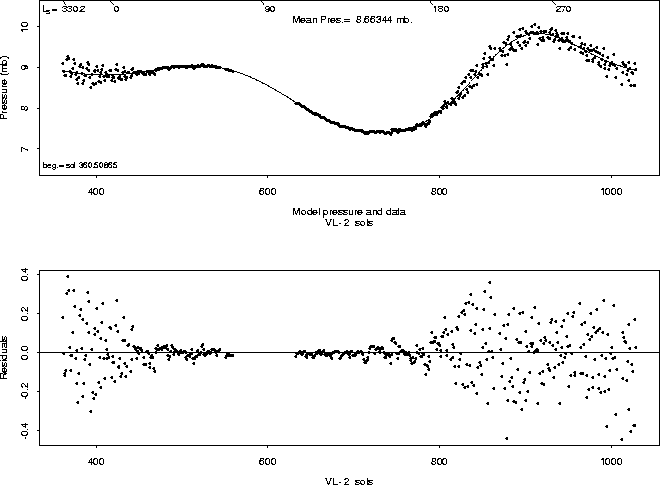
 N
site. The weights used for fitting these data were the reciprocal of a set of
interpolated points between variances of 50 sol blocks of data.
N
site. The weights used for fitting these data were the reciprocal of a set of
interpolated points between variances of 50 sol blocks of data.