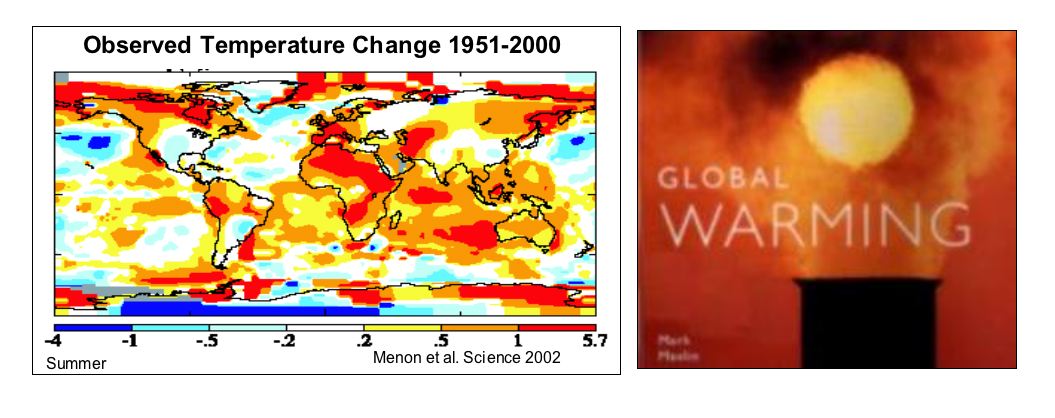
Global warming, population growth, and land use changes are closely interrelated forcings that may cause significant changes in future air quality.
We're employing a comprehensive modeling approach to assess the probable effects of global climate change on US regional air quality.
Our study focuses on the effects of global change on air quality in two regions, the Pacific Northwest and the Northern Midwest.
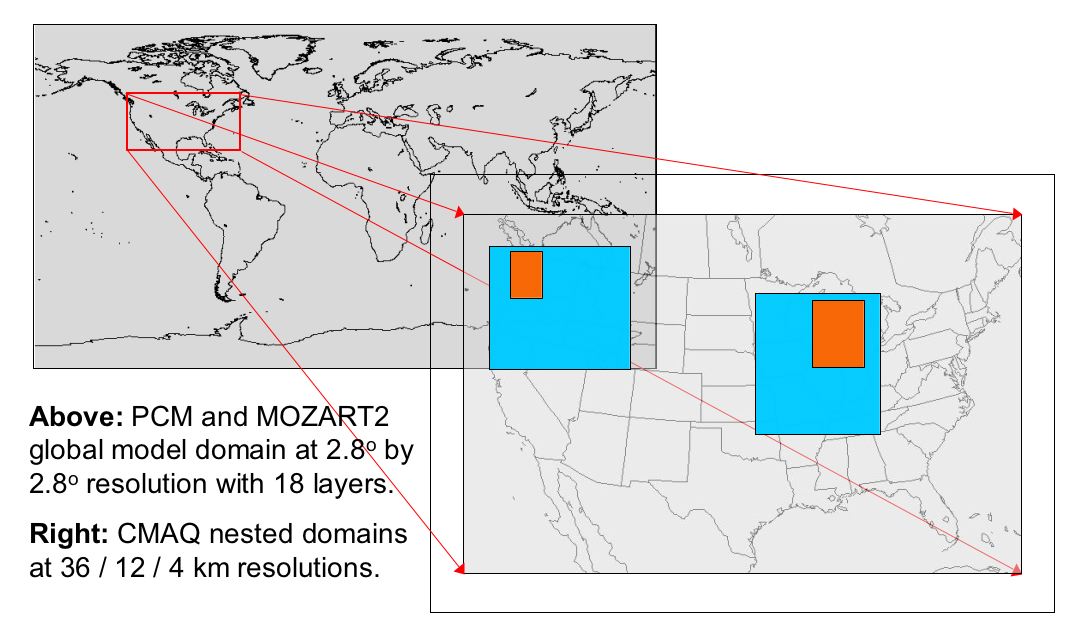
The modeling system is comprises nested regional scale models within global scale models. The global models predict the general trends relating to global climate change while the regional models refine the changes and reflect the effects on air quality.
The NCAR/DOE PCM global climate model and the NCAR MOZART2 global chemistry models provide initial conditions and time dependent boundary conditions to the MM5 / SMOKE / CMAQ regional air quality modeling system. MM5 is a mesoscale meteorology model; SMOKE is an emissions modeling system; and CMAQ is a multi-scale chemical transport model.
To resolve urban scale details in predicted air quality changes, the regional simulations are further nested down from a 36-km US continental scale to urban scales of 12 and 4 km.
The targeted future decade of 2045 - 2055. For comparison and to evaluate the modeling system, we established a contemporary base case simulation for 1990 - 2000. Decade-long simulations are desirable to average out the effects of inter-annual climate variability.

Based on National Emissions Trend 1999 (NET99) data from EPA. Future emissions will be projected using emission growth factors from EPAÕs Economic Growth Analysis System (EGAS), the Intergovernmental Panel on Climate Change (IPCC) and the literature.
A new model, Model of Exchange of Gases between the Atmosphere and Nature (MEGAN), will be used to model over 50 individual biogenic emission species. MEGAN includes improved methods for characterizing land cover type, biomass density and various environmental stress factors. This model also accounts for both long and short term changes in growth environment.
A Stochastic Fire Scenario Builder (FSB) will be used to estimate prescribed and wild land fire emissions. Fire occurrences will be located on lands based on projected fire probability distribution functions. The spatial and temporal extent of fires will depend on climatology, land use changes, fire management practices and historical fire records.
This project is funded through the EPA STAR collaborative grant.