| Mathematics | |
Matrix Powers and Exponentials
This section tells you how to obtain the following matrix powers and exponentials in MATLAB:
Positive Integer Powers
If A is a square matrix and p is a positive integer, then A^p multiplies A by itself p times.
X = A^2

X =
     3     6    10
     6    14    25
    10    25    46
Inverse and Fractional Powers
If A is square and nonsingular, then A^(-p) multiplies inv(A) by itself p times.
Y = B^(-3)

Y =
    0.0053   -0.0068    0.0018
   -0.0034    0.0001    0.0036
   -0.0016    0.0070   -0.0051
Fractional powers, like A^(2/3), are also permitted; the results depend upon the distribution of the eigenvalues of the matrix.
Element-by-Element Powers
The .^ operator produces element-by-element powers. For example,
X = A.^2

A =
     1     1     1
     1     4     9
     1     9    36
Exponentials
sqrtm(A)
computes A^(1/2) by a more accurate algorithm. The m in sqrtm distinguishes this function from sqrt(A) which, like A.^(1/2), does its job element-by-element.
A system of linear, constant coefficient, ordinary differential equations can be written
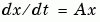
where x = x(t) is a vector of functions of t and A is a matrix independent of t. The solution can be expressed in terms of the matrix exponential,
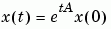
expm(A)
computes the matrix exponential. An example is provided by the 3-by-3 coefficient matrix
A =
     0    -6    -1
     6     2   -16
    -5    20   -10
and the initial condition, x(0)
x0 =
     1
     1
     1
The matrix exponential is used to compute the solution, x(t), to the differential equation at 101 points on the interval 0  t 1 with
X = [];
for t = 0:.01:1
   X = [X expm(t*A)*x0];
end
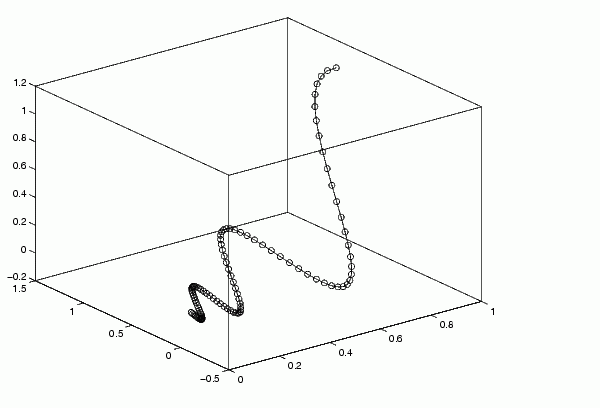
A three-dimensional phase plane plot obtained with
plot3(X(1,:),X(2,:),X(3,:),'-o')
shows the solution spiraling in towards the origin. This behavior is related to the eigenvalues of the coefficient matrix, which are discussed in the next section.
| | QR Factorization | Eigenvalues | |