| Mathematics | |
Difference Equations and Filtering
MATLAB has functions for working with difference equations and filters. These functions operate primarily on vectors.
Vectors are used to hold sampled-data signals, or sequences, for signal processing and data analysis. For multi-input systems, each row of a matrix corresponds to a sample point with each input appearing as columns of the matrix.
y = filter(b, a, x)
processes the data in vector x with the filter described by vectors a and b, creating filtered data y.
The filter command can be thought of as an efficient implementation of the difference equation. The filter structure is the general tapped delay-line filter described by the difference equation below, where n is the index of the current sample, na is the order of the polynomial described by vector a and nb is the order of the polynomial described by vector b. The output y(n), is a linear combination of current and previous inputs, x(n) x(n-1) ..., and previous outputs, y(n-1) y(n-2) ...
 .
.
Suppose, for example, we want to smooth our traffic count data with a moving average filter to see the average traffic flow over a 4-hour window. This process is represented by the difference equation

a = 1;
b = [1/4 1/4 1/4 1/4];
load count.dat
creates the matrix count in the workspace.
For this example, extract the first column of traffic counts and assign it to the vector x.
x = count(:,1);
The 4-hour moving-average of the data is efficiently calculated with
y = filter(b,a,x);
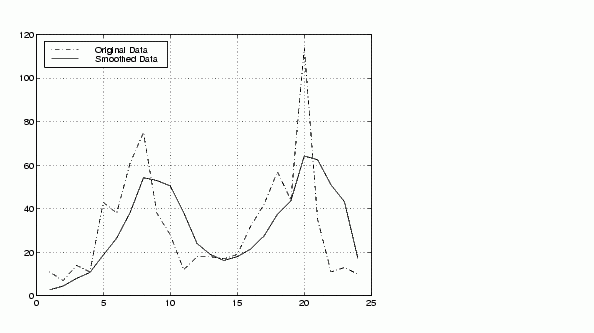
Compare the original data and the smoothed data with an overlaid plot of the two curves.
t = 1:length(x);
plot(t,x,'-.',t,y,'-'), grid on
legend('Original Data','Smoothed Data',2)
The filtered data represented by the solid line is the 4-hour moving average of the observed traffic count data represented by the dashed line.
For practical filtering applications, the Signal Processing Toolbox includes numerous functions for designing and analyzing filters.
| | The Basic Fitting Interface | Fourier Analysis and the Fast Fourier Transform (FFT) | |