

| Signal Processing Toolbox | |
Convert digital filter second-order section parameters to state-space form.
Syntax
[A,B,C,D]=sos2ss(sos) [A,B,C,D]=sos2ss(sos,g)
Description
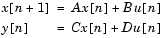
sos2ss converts a second-order section representation of a given digital filter to an equivalent state-space representation.
[A,B,C,D] = sos2ss(sos)
sos, in second-order section form, to a single-input, single-output state-space representation.
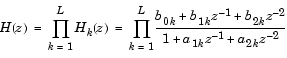
The discrete transfer function in second-order section form is given by
sos is a L-by-6 matrix organized as
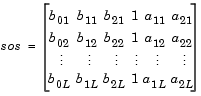
The entries of sos must be real for proper conversion to state space. The returned matrix A is size N-by-N, where N = 2L-1, B is a length N-1 column vector, C is a length N-1 row vector, and D is a scalar.
[A,B,C,D] = sos2ss(sos,g)
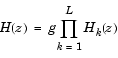
sos in second-order section form with gain g.
Example
Compute the state-space representation of a simple second-order section system with a gain of 2.
sos=[1 1 1 1 0 -1; -2 3 1 1 10 1]; [A,B,C,D]=sos2ss(sos) A = -10 0 10 1 1 0 0 0 0 1 0 0 0 0 1 0 B = 1 0 0 0 C = 21 2 -16 -1 D = -2
Algorithm
sos2ss first converts from second-order sections to transfer function using sos2tf, and then from transfer function to state-space using tf2ss.
See Also
|
Convert digital filter second-order section parameters to transfer function form. |
|
Convert digital filter second-order section parameters to zero-pole-gain form. |
|
Convert state-space data for a digital filter to second-order sections form. |
|
Convert transfer function data for a filter to state-space form. |
|
Convert zero-pole-gain data for a filter to state-space form. |
| | sos2cell | sos2tf | |