

| Signal Processing Toolbox | |
Convert digital filter second-order section parameters to zero-pole-gain form.
Syntax
[z,p,k]=sos2zp(sos) [z,p,k]=sos2zp(sos,g)
Description
sos2zp converts a second-order section representation of a given digital filter to an equivalent zero-pole-gain representation.
[z,p,k] returns the zeros = sos2zp(sos)
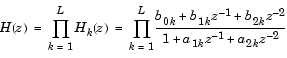
z, poles p, and gain k of the system given by sos in second-order section form. The second-order section format of H(z) is given by
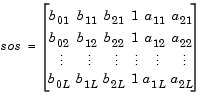
sos is an L-by-6 matrix that contains the coefficients of each second-order section in its rows.
Column vectors z and p contain the zeros and poles of the transfer function H(z).

where the orders n and m are determined by the matrix sos.
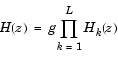
[z,p,k] returns the zeros = sos2zp(sos,g)
z, poles p, and gain k of the system given by sos in second-order section form with gain g.
Example
Compute the poles, zeros, and gain of a simple system in second-order section form.
sos = [1 1 1 1 0 -1; -2 3 1 1 10 1];[z,p,k] = sos2zp(sos)z =-0.5000 + 0.8660i-0.5000 - 0.8660i1.7808-0.2808p =-1.00001.0000-9.8990-0.1010k =-2
Algorithm
sos2zp finds the poles and zeros of each second-order section by repeatedly calling tf2zp.
See Also
|
Convert digital filter second-order section parameters to state-space form. |
|
Convert digital filter second-order section parameters to transfer function form. |
|
Convert state-space filter parameters to zero-pole-gain form. |
|
Convert transfer function filter parameters to zero-pole-gain form. |
|
Convert digital filter zero-pole-gain parameters to second-order sections form. |
| | sos2tf | sosfilt | |