

| Signal Processing Toolbox | |
Convert transfer function filter parameters to zero-pole-gain form.
Syntax
[z,p,k] = tf2zp(b,a)
Description
tf2zp finds the zeros, poles, and gains of a transfer function.
[z,p,k] finds the matrix of zeros = tf2zp(b,a)
z, the vector of poles p, and the associated vector of gains k from the transfer function parameters b and a:
b. a.Given a SIMO continuous-time system in polynomial transfer function form


you can use the output of tf2zp to produce the single-input, multioutput (SIMO) factored transfer function form


The following describes the input and output arguments for tf2zp:
a specifies the coefficients of the denominator polynomial A(s) (or A(z)) in descending powers of s (z-1). b represents the coefficients of the ith numerator polynomial (the ith row of B(s) or B(z)). Specify as many rows of b as there are outputs. b to be less than or equal to the length na of the vector a.b to be equal to the length na of the vector a. You can use the function eqtflength to provide equal length vectors in the case that b and a are vectors of unequal lengths. Otherwise, pad the numerators in the matrix b (and, possibly, the denominator vector a) with zeros.z, with as many columns as there are rows in b. p and the gains for each numerator transfer function in the vector k. The tf2zp function is part of the standard MATLAB language.
Example
Find the zeros, poles, and gains of the discrete-time system
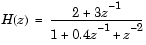
b=[2 3]; a=[1 0.4 1]; [b,a] = eqtflength(b,a);% Make lengths equal. [z,p,k]=tf2zp(b,a) % Obtain the zero-pole-gain form. z = 0 -1.5000 p = -0.2000 + 0.9798i -0.2000 - 0.9798i k = 2
See Also
|
Convert digital filter second-order sections parameters to zero-pole-gain form. |
|
Convert state-space filter parameters to zero-pole-gain form. |
|
Convert digital filter transfer function parameters to second-order sections form. |
|
Convert transfer function filter parameters to state-space form. |
|
Convert zero-pole-gain filter parameters to transfer function form. |
| | tf2ss | tfe | |