


Sol average pressures from all valid measurements during each sol were used for this study. The nominal meteorological sampling strategy used 17 to 96 min measurement intervals, depending on the Lander and the phase of the mission, while engineering requirements sometimes returned many samples per second for short bursts: each point was weighted proportionally to the time span it represented. At times, communications errors or outages interrupt this sampling within the sol, or for a period of sols: the large gaps of Figure 1 are mostly due to the heavy use of the NASA Deep Space Network by Voyager during the Jupiter and Saturn encounter. To insure representative sol mean pressures, we developed and implemented a procedure over the past decade, to exclude sols with data gaps of 6 hours or more. No estimates of the standard deviation of the individual sol pressure estimates have been made, since it changes dramatically with season, sampling, Lander, mission phase, Deep Space Network link quality, and data collection scenario. For example, on some sols the pressure appears constant, there being no variation great enough to cause a one digital number change. These sol average pressures, and statistics, have been supplied with documentation to the National Space Science Data Center (NSSDC) in 1985, and the NASA Planetary Data System, by Tillman and Guest [1983], and are available to the community as digital tapes and microfiche from NSSDC, and are online at the Planetary Data System.
The large, approximately  ,
annual variation of pressure by
sublimation and condensation of the polar caps, combined with the
large gaps in the data, necessitate the use of several harmonics of
the annual cycle even to obtain a reasonably accurate mean pressure.
Gaps in the data preclude simple averaging to obtain an accurate mean
pressure, or smoothing to obtain a precise representation of the low
frequency variation of the annual cycle. After experiments, a mean,
fundamental and four harmonic representation was used for the
condensation-sublimation cycle, which is primarily controlled by the
orbital parameters of Mars. Starting and ending sols were chosen such
that each year began and ended on sols with valid pressures, rather
than a gap, and to include one year of Lander 2 data. Lander 1, sol
405,
,
annual variation of pressure by
sublimation and condensation of the polar caps, combined with the
large gaps in the data, necessitate the use of several harmonics of
the annual cycle even to obtain a reasonably accurate mean pressure.
Gaps in the data preclude simple averaging to obtain an accurate mean
pressure, or smoothing to obtain a precise representation of the low
frequency variation of the annual cycle. After experiments, a mean,
fundamental and four harmonic representation was used for the
condensation-sublimation cycle, which is primarily controlled by the
orbital parameters of Mars. Starting and ending sols were chosen such
that each year began and ended on sols with valid pressures, rather
than a gap, and to include one year of Lander 2 data. Lander 1, sol
405,
 ,
near the end of the 1977 B great storm, is
chosen to be the beginning of the first year without `` great'' or
`` global'' dust storms, so that two relatively
`` clear'' years at Lander 1 could be compared. The first
,
near the end of the 1977 B great storm, is
chosen to be the beginning of the first year without `` great'' or
`` global'' dust storms, so that two relatively
`` clear'' years at Lander 1 could be compared. The first
 of LS probably are influenced by the decaying 1977 B
storm due to the requirement for one corresponding Lander 2 year.
Values were then computed for the year for the mean, fundamental and
the first four harmonics, using weighted least squares for periodic
data, with the weights determined from the reciprocal of variability
of the residual series averaged over 50 sol intervals. This weighted
the fit more heavily toward the low variability late
spring-summer-early fall rather than the very high variability late
fall-winter-early spring seasons. For Lander 1, the weighting was
subjectively fitted to a function
chosen to be periodic over a year, as would be the case if there is a
`` nominal'' Mars year. For Lander 2, interpolation was used for
the weights since modeling produced a less satisfactory result due to
the large point to point variability even with 50 sol averages. The
mean and harmonics were then used to construct the spectral model for
each year and this annual cycle was subtracted from the data to form
the residual series. Phases of each component are given in terms of
LS, as is the season of the maximum of the function. Amplitude
(
of LS probably are influenced by the decaying 1977 B
storm due to the requirement for one corresponding Lander 2 year.
Values were then computed for the year for the mean, fundamental and
the first four harmonics, using weighted least squares for periodic
data, with the weights determined from the reciprocal of variability
of the residual series averaged over 50 sol intervals. This weighted
the fit more heavily toward the low variability late
spring-summer-early fall rather than the very high variability late
fall-winter-early spring seasons. For Lander 1, the weighting was
subjectively fitted to a function
chosen to be periodic over a year, as would be the case if there is a
`` nominal'' Mars year. For Lander 2, interpolation was used for
the weights since modeling produced a less satisfactory result due to
the large point to point variability even with 50 sol averages. The
mean and harmonics were then used to construct the spectral model for
each year and this annual cycle was subtracted from the data to form
the residual series. Phases of each component are given in terms of
LS, as is the season of the maximum of the function. Amplitude
(
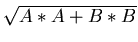 )
and phase (arctan(B/A)) functions are calculated
for each component, where A and B are the respective cosine and sine
amplitudes obtained from the least squares fit. Error estimates
(standard deviations) are the square roots of the first order Taylor
series expansion of the variance of the amplitude, and of the phase
functions. These results are compared with the interannual differences
for the two Lander 1 years.
)
and phase (arctan(B/A)) functions are calculated
for each component, where A and B are the respective cosine and sine
amplitudes obtained from the least squares fit. Error estimates
(standard deviations) are the square roots of the first order Taylor
series expansion of the variance of the amplitude, and of the phase
functions. These results are compared with the interannual differences
for the two Lander 1 years.