


Wood and Paige [1992] have developed a diurnal and seasonal
thermal model of
the seasonal exchange of  between the atmosphere and the polar
caps. For this model, they have fitted the Lander pressure data by
``averaging all of the pressures within 7 sols of each point and
filling small gaps of less than 15 sols by interpolation.'' They used
a 6 hour maximum time gap criteria within the sol to accept or reject
the sol. Our fit of the annual pressure cycle differs from theirs in
two major ways: (1) we do not smooth or interpolate the data and, more
importantly, (2) we fit the data to the fundamental and harmonics of
the annual cycle, the first few being related to the controlling
physics of the orbital parameters. Our results are presented as
analytical functions with specific parameters which can be used to
generate a `` nominal, low dust'' model of the Martian annual
cycle for comparison with all models and future results.
Paige
and Wood [1992] extensively discuss the interannual variations and dust storm
effects in terms of the dust storm and interannual variability of the
parameters of their radiative model.
between the atmosphere and the polar
caps. For this model, they have fitted the Lander pressure data by
``averaging all of the pressures within 7 sols of each point and
filling small gaps of less than 15 sols by interpolation.'' They used
a 6 hour maximum time gap criteria within the sol to accept or reject
the sol. Our fit of the annual pressure cycle differs from theirs in
two major ways: (1) we do not smooth or interpolate the data and, more
importantly, (2) we fit the data to the fundamental and harmonics of
the annual cycle, the first few being related to the controlling
physics of the orbital parameters. Our results are presented as
analytical functions with specific parameters which can be used to
generate a `` nominal, low dust'' model of the Martian annual
cycle for comparison with all models and future results.
Paige
and Wood [1992] extensively discuss the interannual variations and dust storm
effects in terms of the dust storm and interannual variability of the
parameters of their radiative model.
Figure 2a shows the sol average pressure measurements and the curve
determined by fitting a mean, fundamental and the first four harmonics
of the annual cycle, while Figure 2b shows the residual after
subtracting this spectral model from the data. Figures 3a and
3b show
the spectral model for the second ``clear'' year at Lander 1.
There is greater total variability in the second year, since more
measurements were made during the most active late fall-winter-early
spring season, than in year 1, due to year 1 data loss. Table 1
presents the Lander 1 results for the two modeled years. The mean
pressures for both years agree to within 0.0057 mbar, while the standard
deviations are 0.0050 and 0.0036 mbar for years 1 and 2, respectively.
This agreement is far better than the precision of the calibration,
and less than 1/10 of the basic quantization increment (Note: The
quantization limit was 0.088 mbar, the calibration accuracy around 0.02
mbar and there was a significant temperature dependence for the
transducer at zero pressure. According to Viking tests and to the
vendor, Tavis Corporation, these sensors do have temperature dependent
shifts of the zero pressure reading but the sensors are very stable
and the temperature dependence is very repeatable.). It is possible
that the agreement is due to sensor drifts compensating for real
interannual variability but it is hard to imagine a scenario producing
such an accurate agreement of the mean: this is supported by the
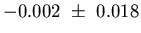
harmonic amplitudes and phases, discussed later. Previously, it has
been noted that the pressure for a 31 sol segment agreed to
 mbar [Hess et al., 1980], with similar conclusions
about the drift.
mbar [Hess et al., 1980], with similar conclusions
about the drift.
Figure 4 illustrates the amplitudes and phases of the mean, fundamental and harmonics for year 1 and year 2 along with their standard deviations. The interannual differences of the means are within approximately one standard deviation of each other. The fundamental amplitudes and phases are also within one standard deviation of each other. The first and second harmonics differ significantly, by approximately three sigma while the third differ by approximately two sigma. Finally, the fourth harmonics are essentially identical. It is significant to note that the phase of the first year precedes that of the second year in all cases while the amplitudes of the fundamental and first three harmonics for the first year are always larger than the second year. The decrease in pressure during northern hemisphere early summer is consistent with the year-to-year phase shift. As previously mentioned, these differences may simply reflect the influence of the decaying 1977 B storm and changes in the the large scale circulation of the atmosphere, such as the variation in the Hadley circulation between dusty and clear years [Zurek et al., 1992]. Even though we suggest that both years are `` nominal, low dust'', years, it should be remembered that near the end of the second of these years, between sols 1720 and 1760, dust piles were removed at the Lander 1 site, [Arvidson et al., 1983], potentially supporting these slight year to year differences.
In comparing these differences, it should be remembered that there are large gaps in the time series and that these gaps are in different seasons for both years. Several variations of the analyses have been used while developing this model and, in some cases, they give significantly different results. For example, simple interpolation over all gaps and unweighted least squares produces far closer interannual phase agreement than do these weighted, noninterpolated results. These differences will be the subject of future studies but it is important to mention them here as our initial analysis, and those of Wood and Paige [1992], used interpolation, a common procedure, to fill in missing data. Such a fill-in procedure generates a spurious accuracy in the parameter estimates.
The maximum pressure, as reconstructed from the model is at
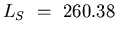 for the first year and at
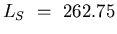 for the second
Lander 1 year. The very close agreement of the two selected Lander 1
years, leads us to suggest that their annual pressure cycle is close
enough for either of them to be used as the basis of a Martian
``nominal or standard'' annual pressure cycle for low latitudes and low
global dustiness. By carefully shifting the starting time later by
about
for the second
Lander 1 year. The very close agreement of the two selected Lander 1
years, leads us to suggest that their annual pressure cycle is close
enough for either of them to be used as the basis of a Martian
``nominal or standard'' annual pressure cycle for low latitudes and low
global dustiness. By carefully shifting the starting time later by
about
 ,
it may be possible to obtain two years which
have closer amplitudes and phases and a composite which is a better
`` nominal Mars'' pressure cycle. Although not included in this
discussion, a Lander 1 sequence started at the beginning of the
mission, including the first two dust storms, has quite different
model parameters as would be expected. [Paige and Wood, 1992] and
[Wood and Paige, 1992] have discussed these differences.
,
it may be possible to obtain two years which
have closer amplitudes and phases and a composite which is a better
`` nominal Mars'' pressure cycle. Although not included in this
discussion, a Lander 1 sequence started at the beginning of the
mission, including the first two dust storms, has quite different
model parameters as would be expected. [Paige and Wood, 1992] and
[Wood and Paige, 1992] have discussed these differences.
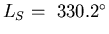
Figures 5a and 5b, and Table 2, illustrate the Lander 2
data for the
same sols corresponding to the Lander 1 sequence starting at sol 405,
 .
These values use the same procedures except that
the weighting for the fits consists of interpolated weights instead of
a model of the weights as for Lander 1. For comparison with Lander 1,
the amplitudes of the fundamental and each harmonic are normalized by
multiplying by the ratio of the Lander 1 to Lander 2 pressure. On
this basis, the fundamental is 90% of the Lander 1 first year values
while the first, second and third harmonics increase from 102% to
112% and the fourth decreases to 87%. If the fit using the modeled
weights is used instead of the interpolated one, all elements are
similar except for the third harmonic. For the present, we suggest
that this Lander 2 cycle, corresponding to the first of the above
years, be considered representative of the same type of year at this
location, and used as the basis of a Lander 2 pressure cycle, until
more data become available.
.
These values use the same procedures except that
the weighting for the fits consists of interpolated weights instead of
a model of the weights as for Lander 1. For comparison with Lander 1,
the amplitudes of the fundamental and each harmonic are normalized by
multiplying by the ratio of the Lander 1 to Lander 2 pressure. On
this basis, the fundamental is 90% of the Lander 1 first year values
while the first, second and third harmonics increase from 102% to
112% and the fourth decreases to 87%. If the fit using the modeled
weights is used instead of the interpolated one, all elements are
similar except for the third harmonic. For the present, we suggest
that this Lander 2 cycle, corresponding to the first of the above
years, be considered representative of the same type of year at this
location, and used as the basis of a Lander 2 pressure cycle, until
more data become available.
For Figures 2, 3, and 5 the modeled pressure can be reconstructed as a simple equation using the amplitudes and phases from Tables 1 and 2 as appropriate for the modeled year and Lander. The general form is
![\begin{displaymath}\rm P_{sol} = P_0 + \sum_{i=1}^5 \left[ P_i \>
\sin (2\pi\>i\> (S-S_R)/S_{YR} +
(\Phi_i\> (2\pi/360))) \right] \end{displaymath}](img20.gif)
where SR is the reference sol at the beginning of the analyzed
year and Lander (405.00000, 1073.59692, or 360.50865 for Figures 2, 3,
and 5 respectively), S is the sol number at which the
pressure is desired, SYR is 668.59692 sols per year, P0 is
the mean from the weighted fit, Pi is the amplitude of the ith
component in millibars and  is the corresponding
parenthetical phase in degrees from Table 1 or 2.
is the corresponding
parenthetical phase in degrees from Table 1 or 2.
Although not included here, it would be logical to normalize the Lander 1 and 2 differences with a hydrostatic correction for the different altitudes of the sites. [Hess et al., 1979] calculated the sol average pressure difference due to the elevation differences between Landers 1 and 2, and compared it with the measured differences. They noted that the major difference is accounted for by the hydrostatic approximation, but that there are large synoptic variations and some smaller seasonal ones. Since we have a much larger data set than the half year used by [Hess et al., 1979] this comparison should be repeated. Remembering those differences, the present results could be extrapolated to other locations by using the height difference, the measured or inferred temperatures, and the hydrostatic approximation for comparison with new results and models.
Among the applications of these spectral models are the following.
1.Comparison with spectral models for other years, especially the years with great dust storms.
2.Comparison with spectral models starting at different times in these nominal years to see how much these estimates vary within the two nominal years.
3.A reference for the Mars Observer and Mars 94 missions.
4.Removal of the low frequencies for spectral analyses of the residual nominal and dusty year time series.
5.Direct comparison with radiative, radiative-convective, and GCM models.
6.Engineering environmental models for Mars.