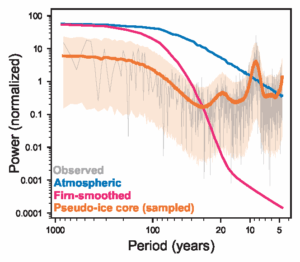
Methane is a powerful greenhouse gas influenced by both human and natural processes. A recent PNAS study by graduate student Eric Mei and Professors Alex Turner and Greg Hakim finds that multidecadal to centennial variability in preindustrial methane levels preserved in ice cores may not require slow climate changes or human activity to explain, but may instead arise from short-term, random fluctuations in the balance between methane sources and sinks, such as year-to-year changes in wetland or fire-related emissions. The results suggest that past methane variability may reflect processes similar to those driving modern year-to-year changes in methane growth.
This study is featured on UW News, and you can read the paper here.