 |
| Marta I. Krynytzky | |
| mkrynytz@u.washington.edu |
|
| arctic climate project | |
| motivations | |
| about AOGCMs | |
| what is the IPCC | |
| methods | |
| results | |
| summary | |
|
all contents copyright
Marta Krynytzky 2005 unless otherwise noted
|
The Effects of Global Warming in High Latitudes:
Reduction of Sea Ice
Results:
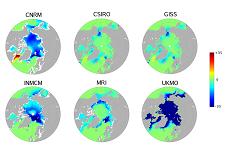
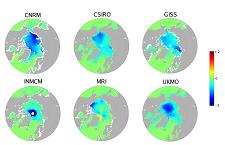
Different models predict different spacial patterns, but all
models predict continuing diminution of the ice pack. For example, in
the Arctic, some models predict changes concentrated near the pole,
whereas others predict changes to occur throughout the arctic or
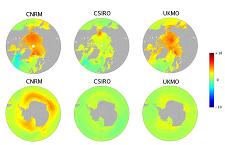
concentrated at the ice edge. In addition, the North and South poles
have very different responses to global climate change. In the 21st
century the Arctic is much more sensitive and has larger predicted
changes than the Antarctic. Due to the large thermal inertia of the
Southern Ocean and the Antarctic Ice sheet, the Antarctic may take
several decades longer than the Arctic to respond to the same overall
global forcing. This large thermal inertia and large Antarctic storms
also lead to greater variability amoung models in the Antarctic
compared to the Arctic. Ice in the Antarctic is thinner than in the
Arctic because the southern ocean transports heat effectively under the
ice. The Arctic ice pack is limited in extent by the surrounding
continents, while Antarctic ice is not.
Figures: (clink to enlarge)
|
Sea Ice Concentration Change
 |
Sea Ice Thickness Change
 |
Suface Air Temperature Change
 |
 |
 |